This post may contain affiliate links. Please read our disclosure policy.
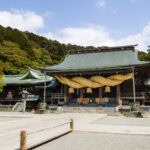
Tucked away in the quiet hills of Sasaguri, Nanzoin is home to one of the largest bronze statues in the world. It also has a vast temple complex, and a sense of calm that is difficult to find anywhere closer to the city.

Nanzoin (南蔵院) is one of 88 sacred temples along the Sasaguri Hachiju Hachikasho pilgrimage route in Fukuoka Prefecture. The circuit is modeled on the famous Shikoku pilgrimage. Legend holds that visiting and praying at each temple on the route helps cleanse past sins. It also brings good fortune to those who complete the journey.
Nanzoin was originally founded on Mount Koya in Wakayama Prefecture, the spiritual heart of Shingon Buddhism, before being relocated to its current hillside location in Sasaguri in 1899. It was undoubtedly one of the most memorable places I visited during my time in Kyushu. The combination of serene nature, impressive Buddhist art, and the sheer scale of the main statue makes it stand apart from most temples I have visited in Japan.
What Is Nanzoin
Nanzoin is a Shingon Buddhist temple complex in the hills of Sasaguri Town, about 25 minutes from Hakata Station by train. It forms part of the 88-temple Sasaguri pilgrimage circuit.
Over the decades, it has grown into a sprawling complex with a main hall, waterfalls, sacred caves, and stone statues. It also has the enormous reclining Buddha that draws visitors from across Japan and beyond. Admission is 300 yen for adults and free for children under 18.
My Experience at Nanzoin

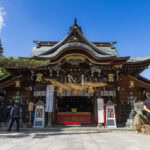
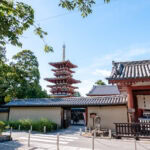
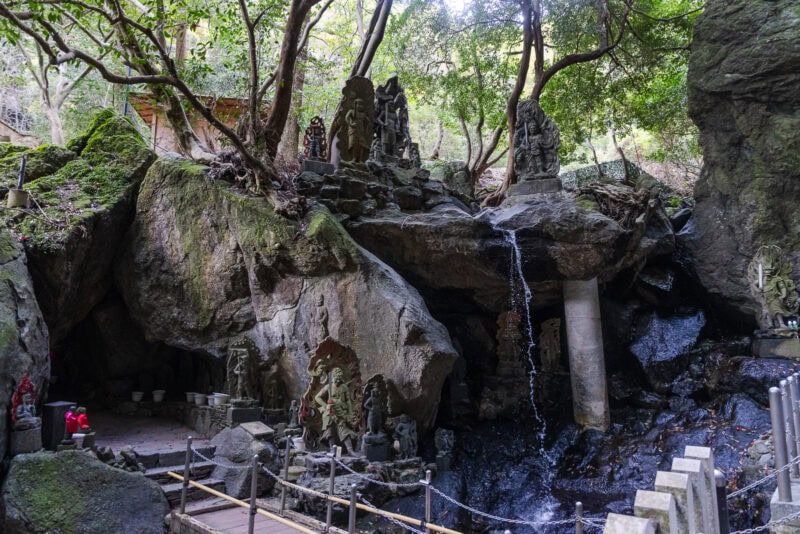
I took my time walking through the grounds rather than heading straight to the main landmark, the Reclining Buddha. The complex has many smaller details worth exploring: the main hall, the powerful Dai-Fudomyoo statue, and a Holy Water Cave. There are also several waterfalls that add to the sense of quiet the whole place carries.
The surrounding hills and trees mean it feels as if you’re somewhere in the countryside, even though Hakata is only a short train ride away.
The Shichifukujin Tunnel
On the right side of the temple grounds is the Shichifukujin Tunnel, a symbolic pathway dedicated to the Seven Gods of Good Fortune and believed to bring luck and blessings to those who pass through it.
The surrounding area features statues representing the seven deities, each associated with different aspects of prosperity, happiness, and longevity. It is a short detour that adds a nice layer to the visit before you reach the main attraction.
The Reclining Buddha
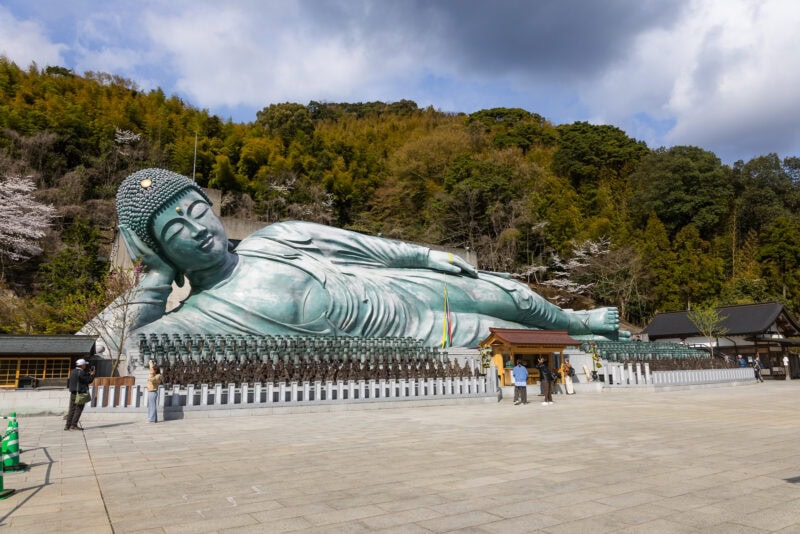
Past the tunnel is the highlight of Nanzoin: the Reclining Buddha, one of the largest bronze statues in the world. The statue depicts the Buddha entering Nirvana and measures 41 meters long and 11 meters tall, weighing approximately 300 tons.
No photograph I had seen prepared me for the actual scale of it in person. Wrapped around the Buddha’s hand are five colored strings attached to the offering box, and it is believed that holding these strings while praying allows worshippers to receive the Buddha’s spiritual energy and blessings of enlightenment.
At the soles of the statue is the Bussoku, or Buddha’s Foot, a sacred symbol in early Indian Buddhism. It represents the compassion and teachings of the Buddha. You can view the statue from a distance or walk right up alongside it, which I recommend. The scale only becomes real when you are standing next to it.
Hundreds of smaller statues of the Buddha’s disciples surround the area, each with a distinct expression and posture. There is a small shop nearby selling drinks and ice cream, and sitting there for a few minutes looking up at the statue made for one of the more unexpectedly peaceful moments of my Kyushu trip.

Andy’s Travel Tips
These simple tips will help you when you visit.
- Dress modestly before you arrive. Clothing should cover your shoulders, stomach, and knees. Revealing attire and visible tattoos are not permitted on the temple grounds. Check the official Nanzoin website for the full dress code details.
- Wear comfortable shoes. The grounds cover a hillside with uneven paths, steps, and slopes between the various areas of the complex.
- Take your time exploring before heading to the reclining Buddha. The main hall, Dai-Fudomyoo statue, Holy Water Cave, and waterfalls are all worth finding and are easy to rush past if you head straight for the main attraction.
- Walk right up alongside the reclining Buddha rather than viewing it only from a distance. The scale of the statue does not fully register until you are standing next to it.
- Pick up a drink or ice cream from the shop near the statue and sit with the view for a few minutes before leaving. It is one of the more peaceful spots to slow down on the whole grounds.
- Last entry is at 16:30, so plan to arrive with enough time to explore the full complex without rushing.
How to Get to Nanzoin
Train
The train is the absolute best and most straightforward way to visit Nanzoin from the city center.
- From Hakata Station, head to Platform 8 and take the JR Fukuhoku Yutaka Line (Sasaguri Line).
- You can take either a local train or a rapid train directly to Kido-Nanzoin-mae Station. The rapid train makes the trip slightly faster. Once you exit Kido-Nanzoin-mae Station, the temple entrance is a flat, easy 3-minute walk away.
Taxi
- A taxi all the way from Hakata Station to the temple takes around 20 minutes. Because of the distance into the valley, the fare is relatively high, usually costing between ¥5,000 and ¥6,000.
Pro Tip: On the short walk from the station to the temple, you will cross the Melody Bridge. This unique concrete bridge features specialized metal plates built into the side railings like a giant xylophone; if you strike them in order with a stick, they play a traditional Japanese children’s tune.
Is Nanzoin Worth Visiting?
Yes, without hesitation. The Reclining Buddha alone justifies the short train ride from Hakata, but the surrounding temple complex completes the whole journey. It is quieter and more contemplative than most Fukuoka attractions.
The hillside setting in Sasaguri gives it a completely different atmosphere from the city. I would recommend it to anyone spending more than a day or two in Fukuoka. This is particularly true if you want something that feels genuinely off the main tourist trail.
More to Explore Nearby
Nanzoin sits in Sasaguri, just east of Fukuoka city, in a valley rich with temples and greenery. The wider Fukuoka region has plenty more to explore.
- Dazaifu Tenmangu — One of Japan’s most celebrated shrines, dedicated to the god of learning and framed by beautiful plum trees. Just a short trip from Sasaguri.
- Kyushu National Museum — A world-class museum in Dazaifu exploring Japan’s cultural exchange with Asia. A natural pairing with a Dazaifu Tenmangu visit.
- Ohori Park — A beloved lakeside park in central Fukuoka, perfect for a relaxed stroll after a day of temple-hopping.
- Munakata Shrine — A UNESCO-listed shrine complex on Fukuoka’s northern coast, steeped in ancient maritime history.
- Uminonakamichi Seaside Park — A vast coastal park on a narrow peninsula east of Fukuoka city, known for its seasonal flower fields and ocean views.