This post may contain affiliate links. Please read our disclosure policy.
From colorful spring tulips to vibrant autumn cosmos, Uminonakamichi Seaside Park is a beautiful coastal escape along Fukuoka’s shore that rewards visitors in every season.

Uminonakamichi Seaside Park (海の中道海浜公園) sits on a narrow peninsula across the bay from central Fukuoka, stretching 6 kilometers along the coast and covering around 300 hectares. It is the kind of park that surprises you with how much it holds.
Seasonal flower gardens, a zoo, playgrounds, cycling paths, sports fields, a summer pool complex, and sweeping coastal views are all here in one place. I visited in the late afternoon and felt as if I could have spent the whole day there. If you want to get out of Fukuoka’s city center without going far, this is one of the easiest and beautiful areas in the city.
What Is Uminonakamichi Seaside Park
Uminonakamichi Seaside Park is a national seaside park managed by the Japanese government, located on the Uminonakamichi peninsula on the eastern side of Hakata Bay. At approximately 300 hectares and 6 kilometers long, it is one of the largest parks in western Japan.
The park is best known for its seasonal flower displays but also has a zoo, an amusement area for children, Japan’s largest resort pool complex in western Japan, and direct access to Marine World Uminonakamichi aquarium on the far side of the station.
Quick Facts
- Located on the Uminonakamichi peninsula, about 40 minutes from Hakata Station by train
- Around 2,000 cherry trees make it one of Fukuoka’s top hanami spots, blooming late March to mid-April
- Nemophila season runs mid-April to early May, blanketing Flower Hill in blue
- The Sunshine Pool is the largest resort pool complex in western Japan, open in summer
My Experience at Uminonakamichi Seaside Park

The first thing I did was head to Flower Hill, which is the most popular spot in the park. I didn’t realise just how large the park was. If you want to explore the whole park, it is far too large to cover comfortably on foot.
There are various rental cycle shops and cycling paths that weave through all the main areas with good signage. It turns a full day of walking into a relaxed loop you can actually complete without feeling rushed.
Flower Hill and Seasonal Blooms
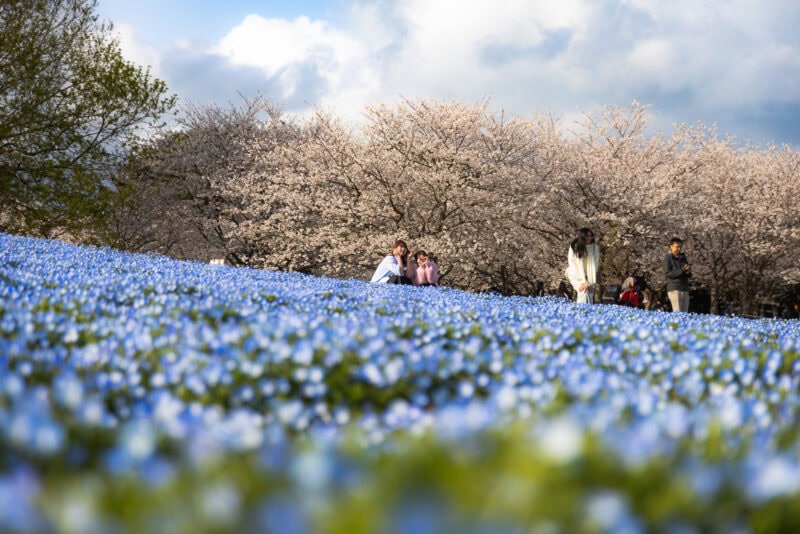
The flowers are what most people come for, and Flower Hill does not disappoint. The best time to visit is mid-April to early May, when nemophila, also known as baby blue eyes, covers the hillside in a dense blue blanket. If you time it right, the nemophila can overlap with the tail end of the cherry blossom season, which runs from late March to mid-April.
With around 2,000 cherry trees spread across the park, it is already one of Fukuoka’s best hanami (cherry blossom viewing) spots on its own. Beyond spring, the park cycles through sunflowers, roses, cosmos, and tulips, so there is always something in bloom regardless of when you visit.
Wonder World, Sunshine Pool, and Open Spaces
Across the park there are large open lawns where locals picnic and relax, and day camping is available with rental barbecue equipment if you want to make a full afternoon of it. For families with children, Wonder World is a small amusement area with mazes, go-karts, and a mini SL locomotive that kids tend to love.
In summer, the Sunshine Pool opens with six pools including slides and a water jungle, making it a serious draw for both children and adults looking to beat the Fukuoka heat.
Animal Forest and Marine World
Inside the park, Animal Forest is a compact zoo with capybaras, kangaroos, flamingos, and other animals that works well as a stop along the cycling route. On the far side of Uminonakamichi Station is Marine World Uminonakamichi, a separate aquarium featuring dolphins, sea lions, sea turtles, and the rich marine life of the Kyushu region.
It is worth noting that Marine World has its own separate admission and is a distinct facility from the park itself, so factor in the extra time and cost if you plan to visit both.


Andy’s Travel Tips
These simple tips will help you when you visit.
- Rent a bike at the entrance as soon as you arrive. The park is 6 kilometers long and cycling is by far the best way to cover all the main areas without exhausting yourself.
- Visit mid-April to early May for the nemophila season on Flower Hill. It is the most visually striking time of year and worth planning your Fukuoka trip around if possible.
- Check if the nemophila overlaps with cherry blossoms when planning your dates. Late March to mid-April is cherry blossom season, and when the two coincide it is one of the best flower experiences in Kyushu.
- Consider the ferry from Momochi Seaside Park as an alternative to the train. The 20-minute ride costs 1,200 yen for adults and is a scenic way to arrive, though the schedule changes by season so check ahead.
- Budget a full half day at minimum, and a full day if you plan to include Marine World, the pool, or Animal Forest. The park is much larger than it looks on a map.
How to Get to Uminonakamichi Seaside Park
By Train
The park has its own dedicated station, making the train the most popular and reliable option.
- From Hakata Station: Take the JR Kagoshima Line (Local or Rapid) to Kashii Station.
- Transfer to the JR Kashii Line (also known as the Uminonakamichi Line) bound for Saitozaki.
- Get off at Uminonakamichi Station. The park entrance is located immediately outside the station.
- Total Time: Approximately 35 to 45 minutes.
- From Tenjin Station: Take the Subway Hakozaki Line to Kaizuka Station.
- Transfer to the Nishitetsu Kaizuka Line and ride to Wajiro Station.
- Transfer to the JR Kashii Line and get off at Uminonakamichi Station.
- Total Time: Approximately 45 to 55 minutes.
By Ferry
For a more scenic journey with views of the Fukuoka skyline, you can take a high-speed ferry across the bay.
- Uminonakamichi Line (Umi-naka Line): Board at the Bayside Place Hakata (near Hakata Port Tower) or Momochi (Marizon) near Fukuoka Tower.
- The boat ride takes about 15 to 20 minutes.
- The ferry terminal at Uminonakamichi is a short walk from both the park entrance and the aquarium.
Is Uminonakamichi Seaside Park Worth Visiting?
Yes, especially if you want a nature escape or if you are traveling with children. The flower displays are impressive, the cycling paths make the scale of the park feel manageable, and there is enough variety here to keep both adults and children happy for a full day.
I would put it high on the list for spring visitors in particular, but the park holds up well in any season. It is one of those places that locals clearly love, and it is easy to see why once you are there.
More to Explore Nearby
- Hakata Port Tower – Enjoy sweeping views over Hakata Bay from this retro landmark — a great way to see the very waters you’ve been strolling alongside from a new perspective.
- Fukuoka Castle – Explore the atmospheric ruins of Fukuoka’s grand feudal castle, set in a sprawling park with seasonal cherry blossoms and city views.
- Dazaifu Tenmangu – Head inland to one of Kyushu’s most celebrated Shinto shrines, surrounded by plum trees and steeped in over a thousand years of history.
- Fukuoka Yatai – End the day at Fukuoka’s legendary open-air yatai stalls, where locals gather for ramen, yakitori, and cold drinks under the night sky.