This post may contain affiliate links. Please read our disclosure policy.
Step into the quiet grounds of Shofukuji Temple, the temple that introduced Zen Buddhism to Japan over 800 years ago and still carries that history in every stone, gate, and wall.

Shofukuji Temple (聖福寺) was founded in 1195 by the priest Eisai, who had studied Zen Buddhism in China. He brought the Rinzai sect back to Japan, making this the first Zen Buddhist temple in the country. It has since influenced the aesthetics and construction of countless Zen temples across Japan. The temple has also been designated a National Historical Site.
The inside of the temple buildings is not accessible to the public, but the surrounding grounds are open and free to explore. It is not the kind of place that demands much time, but what it offers in 30 minutes is a genuine sense of age and quiet in the middle of central Fukuoka.
What Is Shofukuji Temple
Shofukuji Temple is a Rinzai Zen Buddhist temple in the Hakata district of Fukuoka. It was founded by the monk Eisai in 1195 following his return from China. It holds the official designation of Japan’s first Zen temple.
The temple has been rebuilt several times over the centuries due to fires and wars. Its layout, however, preserves the core features of traditional Zen temple architecture. The grounds are open to the public and free to enter, open daily from 8:00 to 17:00.
My Experience at Shofukuji Temple

The first thing I noticed was the Hakata-bei walls that surround the temple. These are not ordinary stone walls. They are built from mud, rocks, and roof tiles salvaged from local battlefields. While most of the surface is covered, there are exposed sections where you can see the layered interior up close. I also liked how, just a couple of side streets away from the busy roads of Hakata, you are surrounded by a peaceful temple as if somewhere in the countryside.
The Sanmon Gate and Butsuden Hall
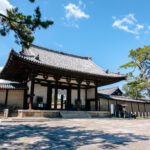
At the heart of the grounds is the Sanmon entrance gate, rebuilt in 1911, with a small pond and bridge in front that add to the calm of the approach. Above the gate hangs a framed tablet inscribed by Emperor Go-Toba, declaring Shofukuji Temple as the first Zen temple in Japan.
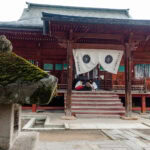
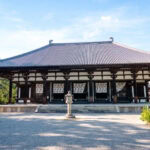
Behind the gate is the Butsuden Hall, which holds a small wooden statue of the historical Buddha flanked by large golden statues on either side, with a cloud dragon painted across the ceiling above. While you cannot enter the hall, you can view it from the entrance and appreciate the detail from there.

Historic Structures and Temple Treasures
The grounds contain several other structures worth taking in as you walk. The Shoro Bell Tower was originally built in 1589 and renovated in 1759. It once housed a bronze bell brought from Korea. The Kuri, or Temple Kitchen, also dates to 1589 and played a central role in daily temple life. It was later restored in the early 20th century. The Hojo Abbot’s Quarters and the Zendo Meditation Hall round out the main complex. Each reflects the Zen philosophy of simplicity and function.
Inside the Buddha Hall, the Sanzebutsu, or Buddhas of the Three Worlds, represent Amida, Shaka, and Miroku: the past, present, and future. The temple grounds also include a cemetery where notable historical figures are buried. These include former Prime Minister Koki Hirota and politician Taketora Ogata. Some of the temple’s other treasures are not accessible to the public on-site. They are occasionally exhibited at Fukuoka City Museum.


Andy’s Travel Tips
These simple tips will help you when you visit.
- Budget about 30 minutes for the visit. The temple interiors are not open to the public, so the experience is a walking tour of the grounds rather than an indoor exploration. That is more than enough time to take it all in properly.
- Look closely at the Hakata-bei walls as you walk the perimeter. The exposed sections reveal the layers of mud, rock, and salvaged battlefield tiles that make up the structure, which is a more interesting detail than it sounds.
- Look up above the Sanmon Gate for the Emperor Go-Toba tablet declaring Shofukuji Temple as Japan’s first Zen temple. It is easy to walk past without noticing.
- Combine with Kushida Shrine on the same visit since both are within easy walking distance in Hakata and together make for a complete morning of history in the neighborhood.
- The temple is a 3-minute walk from Gion Station on the Airport Line, making it one of the easiest historical sites to reach in Fukuoka with no transfers needed from Hakata Station.
How to Get to Shofukuji
Subway
The municipal subway line drops you just steps away from the forested temple grounds.
- Gion Station: This is the absolute closest stop. Take the Kuko Line to this station, look for Exit 4, and the main wooden gates of the temple will be a short, flat 3-minute walk to the north.
Is Shofukuji Temple Worth Visiting?
I don’t think you have to go out of your way to visit the Shofukuji Temple. As most of the structures are fenced off, there is not much to do other than walking around the grounds. However, if you appreciate history, it is worth visiting, as it is a significant temple in the middle of the city and takes only 30 minutes.
More to Explore Nearby
- Kushida Shrine — Hakata’s most beloved shrine and spiritual home of the famous Yamakasa festival, just a short walk away.
- Fukuoka Yatai — Fukuoka’s iconic open-air food stalls, a beloved local tradition best experienced on a warm evening along the riverbanks.
- Dazaifu Tenmangu — One of Japan’s most celebrated shrines, dedicated to the god of learning and easily reached by train from Hakata.
- Kyushu National Museum — A world-class museum in Dazaifu exploring Japan’s cultural ties with the wider Asian world. A natural pairing with a Dazaifu Tenmangu visit.
- Yanagawa Canals — A charming canal town south of Fukuoka, best explored by traditional flat-bottomed boat.