This post may contain affiliate links. Please read our disclosure policy.
Yakushi-ji Temple in Nara is a UNESCO World Heritage Site and one of Japan’s Seven Great Temples, known for its twin pagodas, Buddhist art, and over 1,300 years of history.
A Temple with Ancient Roots
Among Nara’s many historic temples, Yakushi-ji is especially revered for both its architectural beauty and spiritual significance. Founded in 680 by Emperor Tenmu as a prayer for the recovery of his ailing wife, the temple is dedicated to Yakushi Nyorai, the Buddha of Healing.
Originally built in Fujiwara-kyo, Japan’s capital before Nara, Yakushi-ji was moved to its current location around 718. It became one of the legendary Seven Great Temples of Nanto and is now part of the “Historic Monuments of Ancient Nara” UNESCO designation.
Perfect Symmetry and Timeless Design

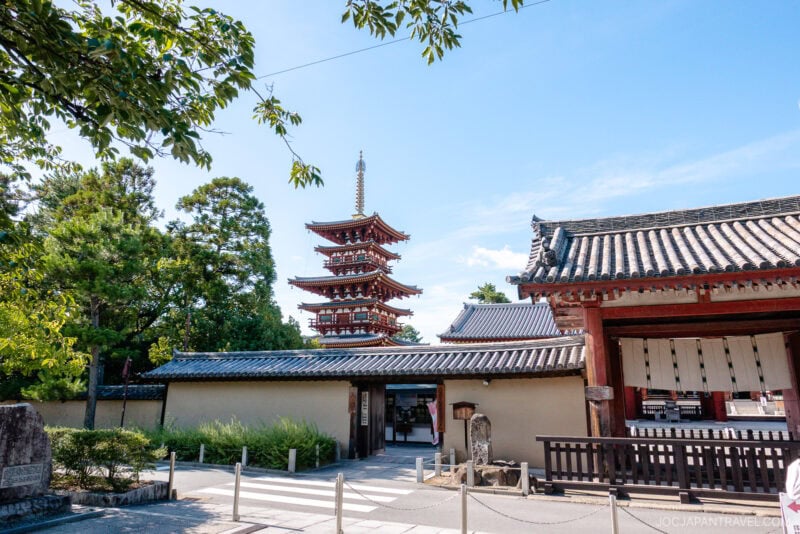
Yakushi-ji’s layout is unusual for a Japanese temple—its main hall, or Kondo, is flanked by two three-storied pagodas that mirror each other. This bilateral symmetry creates a striking balance when viewed from the main approach.
The West Pagoda is a modern reconstruction, while the East Pagoda (Toto) is an original 8th-century structure and Japan’s oldest surviving pagoda. During our visit, the East Pagoda was under restoration, but even from a distance, we could appreciate its graceful proportions and historic presence.
Inside the Golden Hall
The Kondo houses the temple’s principal image: Yakushi Nyorai, seated in bronze and flanked by two attendant bodhisattvas. The statues convey a sense of calm strength, reflecting the compassionate nature of the Buddha of Medicine.
The Genjo-Sanzo-in Garan

A short walk from the main complex leads to the Genjo-Sanzo-in Garan, dedicated to the 7th-century Chinese monk Genjo-Sanzo (Xuanzang), whose pilgrimage to India inspired the famous novel Journey to the West. The precinct includes the Genjo-to Pagoda, said to contain some of his remains, as well as exhibits and murals depicting his travels.
How to Get to Yakushi-ji (薬師寺)
Train
- From Kintetsu Nara Station, take the Kintetsu Nara Line to Yamato-Saidaiji Station (5 minutes), transfer to the Kintetsu Kashihara Line, and ride 1 stop to Nishinokyo Station (2 minutes). From there, it’s a 2-minute walk to the temple entrance. About 20 minutes travel time.
Pro Tip: Pair Yakushi-ji with nearby Toshodai-ji (唐招提寺). It is a 10–15 minute walk for a deeper look at Nara’s Buddhist history.
Is Yakushi-ji Worth Visiting?
Yakushi-ji offers a different experience from Nara’s more crowded attractions like Todai-ji and Kasuga Taisha. The symmetrical layout, historic pagoda, and peaceful grounds create an atmosphere of order and balance, while the Genjo-Sanzo-in Garan adds an unexpected cultural dimension.
More to Explore Nearby
As one of Nara’s revered World Heritage sites, Yakushi-ji Temple is a stunning example of early Japanese Buddhism, placing you in a historical cluster near other ancient temples and the former Imperial Palace site.
- Toshodai-ji Temple – Visit this nearby World Heritage site founded in the 8th century by the Chinese monk Jianzhen, featuring beautiful classical architecture.
- Heijo Palace Site – Explore the expansive grounds of the former Imperial Palace, which served as the center of power during the Nara Period.
- Saidai-ji Temple – Discover the “Great Western Temple,” historically one of Nara’s seven great temples, famous for its impressive wooden statue of the Shaka Triad.
- Horyu-ji Temple – Take a slightly longer trip west to visit what is widely considered the world’s oldest surviving wooden structure, holding a complex of historically significant buildings.