This post may contain affiliate links. Please read our disclosure policy.
Just a short ferry ride from Kagoshima City, Sakurajima is an easy day trip packed with steaming footbaths, lava trails, sweeping observatories, and a front-row seat to one of Japan’s most active volcanoes.
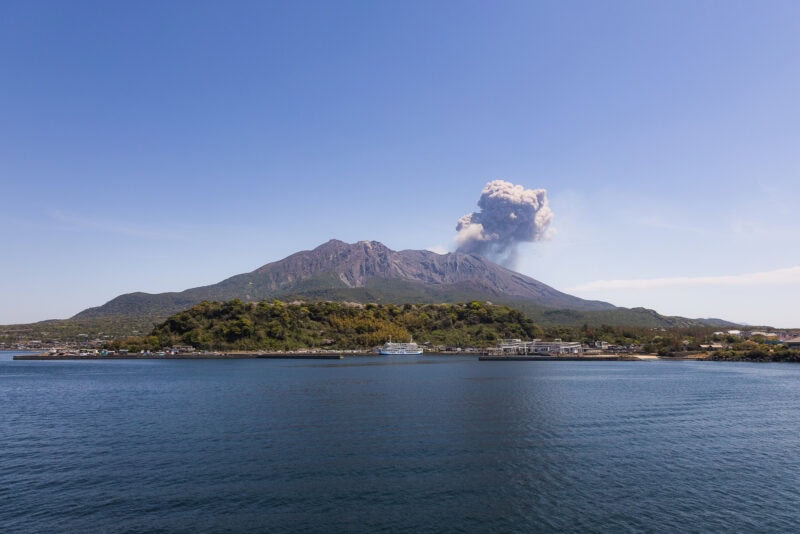
Sakurajima (桜島) is one of Japan’s most active volcanoes and the defining landmark of Kagoshima Prefecture. Sitting just 15 minutes by ferry from Kagoshima Port, it is one of the most accessible active volcanoes in the world, and spending a day here feels unlike anywhere else in Kyushu.
The island averages around 800 eruptions a year, so do not be surprised if you see smoke rising from the crater or hear a distant rumble while you are there. Most eruptions are minor and will not affect your visit. Announcements are made if anything requires attention. I recommend renting a car to get the most out of the island. Even the areas closest to the port, however, have enough to fill a rewarding half day.
What Is Sakurajima
Sakurajima is an active stratovolcano and island in Kagoshima Bay. It is connected to the Osumi Peninsula on the mainland by lava from the massive 1914 eruption. That eruption released over 3 billion tons of volcanic material and permanently changed the island’s geography.
The island has a circumference of approximately 36 kilometers. It is dotted with observatories, lava trails, shrines, footbaths, and natural monuments, most of which are free to visit. It remains an inhabited island with a small local community. This gives it a lived-in character that sets it apart from a typical tourist destination.
Quick Facts
- Located in Kagoshima Bay, 15 minutes by ferry from Kagoshima Port (250 yen one way)
- One of Japan’s most active volcanoes, averaging around 800 eruptions per year
- The 1914 eruption released over 3 billion tons of lava, connecting Sakurajima to the Osumi Peninsula mainland
- Island circumference: approximately 36 kilometers
- Nagisa Park footbath: one of the longest in Japan at 100 meters, free and open 9:00 to sunset
- Sakurajima Island View Bus available for those without a car: one-day pass 500 yen, loops the west side every 30 minutes
My Experience at Sakurajima
The ferry crossing alone sets the tone. Standing on the open deck as Sakurajima grows larger in front of you is extraordinary. Often, a plume of smoke drifts from the crater. It is one of those moments that makes it clear you are somewhere genuinely extraordinary. I rented a car and spent the full day working my way around the island. I stopped at every observatory and lava field I could find. Below are the highlights in roughly the order I visited them.
Sakurajima Visitor Center
Start here before heading anywhere else. The visitor center has a small but well-put-together museum covering the history of Sakurajima and its major eruptions through models, photographs, and videos.
More practically, it has live camera feeds of the volcano, daily eruption counts, and current information on any restricted areas. There is also a small shop with Sakurajima-exclusive goods and rental bicycles. These are available if you want to explore the area around the port on two wheels. It is open 9:00 to 17:00 and free to enter.
Nagisa Park Footbath and Lava Trail
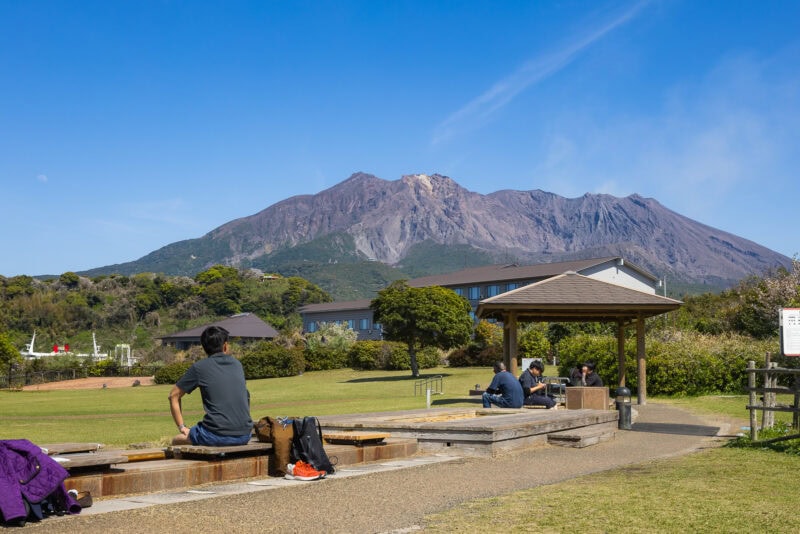
Right next to the visitor center is the Nagisa Park footbath, one of the longest in Japan at 100 meters. It is fed by natural hot spring water sourced from 1,000 meters underground. Depending on which way you face, you get views of Sakurajima rising inland or Kinko Bay and Kagoshima City stretching out to sea.
It is free, and if you forget a towel, you can buy one at the visitor center. I would recommend making this your first stop of the day to ease into the island’s pace before heading further out. Running from the park is the 3-kilometer Nagisa Lava Trail, which follows the coastline across the lava zone created by the 1914 eruption. If you want a full onsen experience rather than just a footbath, Sakurajima Magma Hot Spring nearby has a sauna, cold water bath, electric pulse bath, and jacuzzi.
Karasujima Observatory
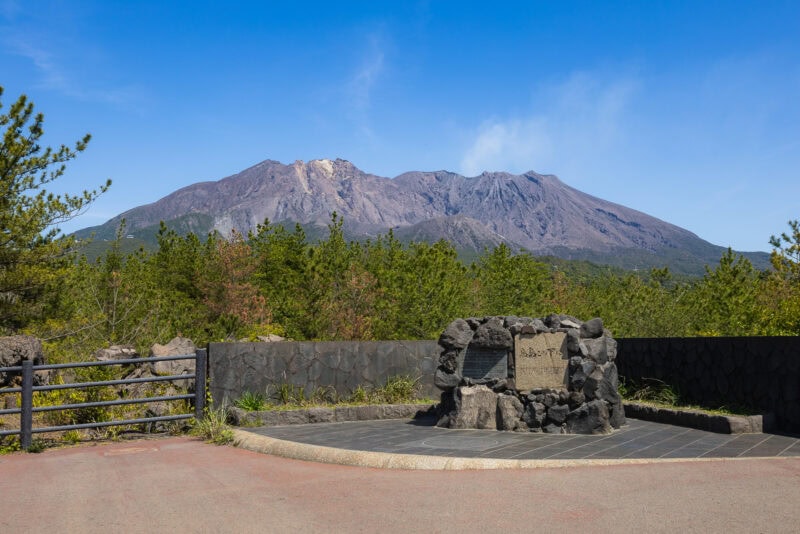
A short way along the Nagisa Lava Trail is Karasujima Observatory, built on what was once a separate small island. This was before the 1914 lava flow swallowed the strait and merged it with Sakurajima. The solidified lava still dominates the landscape here, dark and jagged. Patches of black pine and other vegetation, however, are beginning to reclaim it. More than a century later, the terrain still gives a clear sense of the scale and force of that eruption. It is free and open 24 hours a day.
Yunohira Observatory
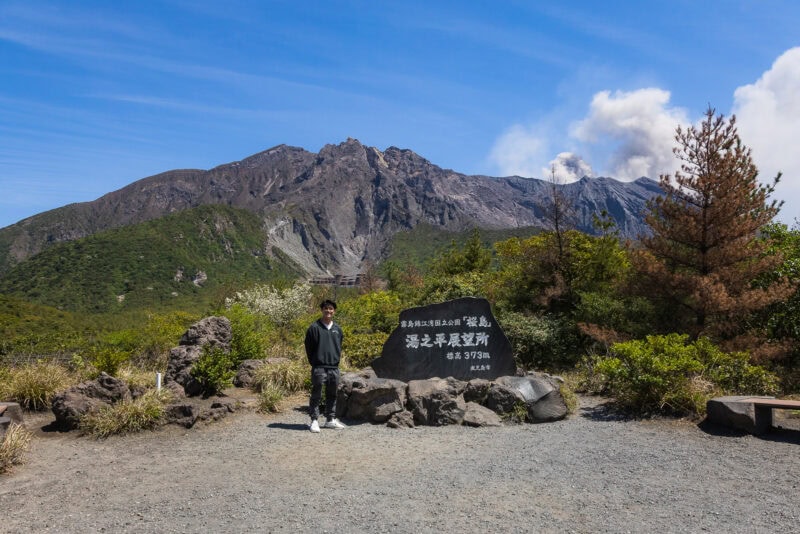
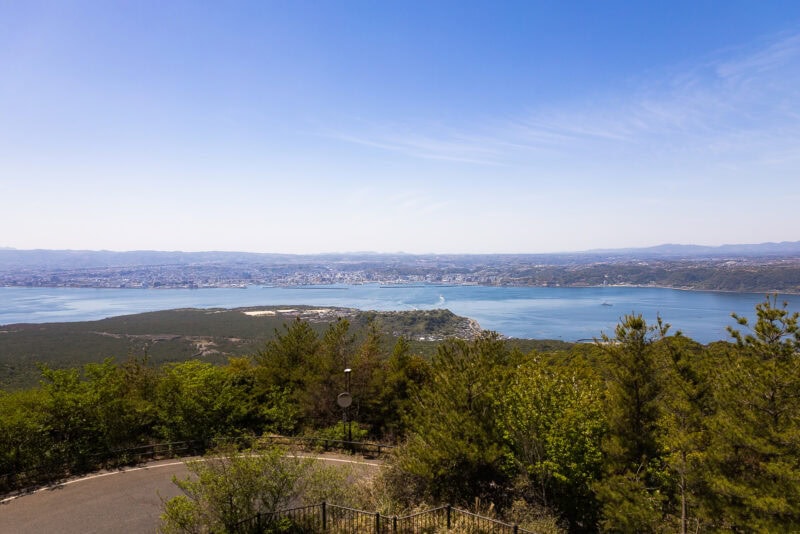
Yunohira Observatory is the highest point accessible to visitors on Sakurajima, at 373 meters above sea level on the north peak. It is closer to the crater than any other viewpoint on the island. The panorama from up here takes in the volcano, Kagoshima City, and the full sweep of Kinko Bay.
I visited during the day, which was impressive enough, but the observatory is most famous for its sunset and night views. At these times, the city lights glow across the bay, and the volcanic crater can take on an orange tinge. There is a small shop inside with drinks and souvenirs. Seven heart-shaped stones are also hidden in the walls and around the structure. It is said that finding all seven brings good luck.
Arimura Lava Observatory

On the south side of the island, Arimura Lava Observatory sits atop a small hill formed by the 1946 eruption, surrounded by lava fields and pine trees. What makes this one different from the others is its proximity to the south peak crater.
Three walking trails branch out from the observatory at different lengths: 450 meters (about 10 minutes), 700 meters (about 15 minutes), and 800 meters (about 20 minutes). Each offers a different angle over the lava fields and the peak. The car park has a rest house with information panels about Sakurajima and its residents. There is also a small shop selling souvenirs including lava rocks, pickles, and ice cream.
Kurokami Buried Shrine Gate
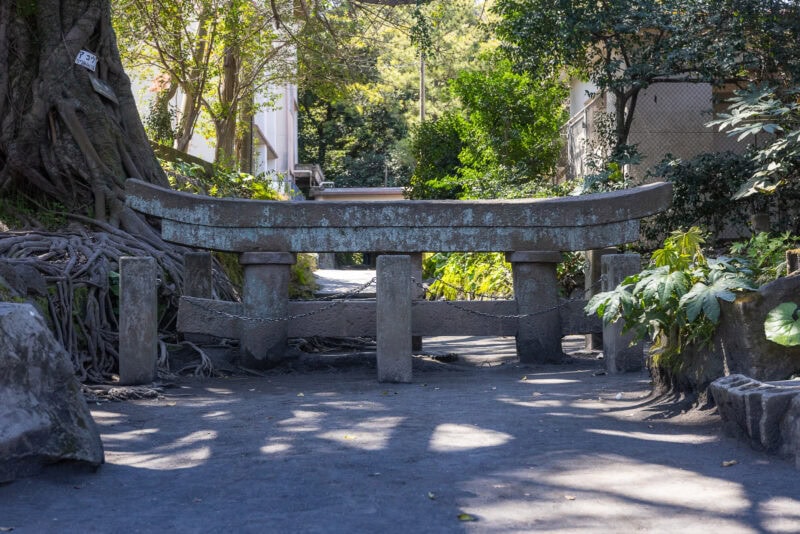
One of the most striking sights on the island is the Kurokami Buried Shrine Gate. Here, the top of a 3-meter torii is visible above the ground. The rest is buried beneath lava from the 1914 eruption. The village head at the time made the decision not to excavate it. He chose instead to leave it as a permanent reminder of the disaster.
That decision has stood for over a century. The gate was designated a natural monument by the prefecture in 1958. Standing in front of it and imagining the lava advancing to this point is a quietly sobering moment in an otherwise scenic day.
Tsukiyomi Shrine
Just in front of Sakurajima Port is Tsukiyomi Shrine, with a history spanning more than 1,300 years. It was relocated from its original site after the 1914 eruption and now sits among subtropical trees, its bright vermilion buildings contrasting sharply with the surrounding greenery and volcanic landscape.
It is a good first or last stop depending on your direction around the island. Visitors can draw two types of omikuji fortune slips: the Hato (dove), symbolizing good luck, and the Fukuro (owl), said to bring even greater fortune.

Andy’s Travel Tips
These simple tips will help you when you visit.
- Rent a car to see the full island. The Sakurajima Island View Bus covers the west side, but a car lets you reach the Arimura Lava Observatory, Kurokami Buried Gate, and the eastern side at your own pace. You can rent one at Sakurajima Car Rental near the port.
- Start at the visitor center to check current volcanic activity, any restricted areas, and the live eruption count for the day before heading out.
- Bring a towel for the Nagisa Park footbath, or pick one up at the visitor center shop. It is one of the longest footbaths in Japan and completely free.
- Time Yunohira Observatory for sunset if your schedule allows. The combination of the city lights across Kinko Bay and the glow of the crater makes it one of the best viewpoints in all of Kagoshima Prefecture.
- Do not be alarmed by eruptions. Minor eruptions happen regularly throughout the day and are part of the experience. Announcements are made if any activity requires you to move or leave an area.
- Taking a car on the ferry costs extra (1,700 yen for cars up to 4 meters, 2,350 yen for 4 to 5 meters), paid at the toll booth after disembarking. If you want to avoid the ferry cost entirely, you can drive to Sakurajima via the eastern route connected to the mainland.
How to Get to Sakurajima
Sakurajima is one of Japan’s most active volcanoes, smoking constantly over the bay of Kagoshima. Once an isolated island, a massive 1914 eruption spilled enough lava to connect it permanently to the peninsula on its eastern side.
Ferry
Taking the ferry directly across Kinko Bay is the most iconic, scenic, and practical way to reach the volcano from the city center.
- From Kagoshima-Chuo Station: Take the city tram or a local bus for about 15 minutes to the Kagoshima Port Ferry Terminal.
- Board the Sakurajima Ferry: This boat runs 24 hours a day. During peak daylight hours, ships depart every 10 to 15 minutes. The cruise across the water takes just 15 minutes.
- Payment: You pay the fare at the gate on the Sakurajima side, meaning you can just walk onto the boat when departing from the city. IC transit cards are fully accepted.
Bus (On the Island)
- Once you disembark at the Sakurajima Ferry Terminal, you can explore the island using the Sakurajima Island View Bus.
- This dedicated hop-on, hop-off loop bus departs from the terminal and stops at major landmarks like the Karasujima Observation Point and the Yunohira Observatory. A full loop takes about 60 minutes.
Car
You have two distinct choices if you want to explore the volcanic roads with a vehicle.
- Via Ferry: You can actually drive your rental car straight onto the Sakurajima Ferry at Kagoshima Port. You simply drive into the boat’s hull, park, walk upstairs to enjoy the crossing, and drive off directly onto the island’s coastal highway.
- Via the Peninsula Land Bridge: If you are coming from the east (like Kanoya or Miyazaki), you can drive straight onto the volcano via Route 220, completely bypassing the ferry since it is connected to the mainland on that side.
Is Sakurajima Worth Visiting?
Without question. Sakurajima is one of the most unique day trips in Japan. It is one of the few places where you can get genuinely close to an active volcano without any serious planning or specialist equipment. The ferry crossing is 250 yen, most attractions are free, and a full day on the island leaves you with views, experiences, and a few quiet moments. Standing in front of a buried shrine gate is difficult to replicate anywhere else. If you are visiting Kagoshima, this is non-negotiable.
More to Explore Nearby
Sakurajima looms large over Kagoshima, but the city and surrounding region offer plenty more dramatic scenery and local flavors to discover.
- Sengan-en — A stunning feudal garden in the heart of the city, framed by Sakurajima’s ever-present silhouette across the bay.
- Kagoshima Sightseeing and Shopping — Tenmonkan arcade is the perfect place to sample Kagoshima’s famous “kurobuta” (black pork) and “shochu” spirits.
- Shiroyama Hotel — A historic luxury hotel perched on a hill above the city, with unbeatable views of the volcano from its outdoor baths.
- Kirishima Shrine — A serene and sacred complex nestled in the volcanic peaks north of the city, steeped in ancient mythology.
- Yakushima Island — A lush, mist-shrouded island of ancient cedar forests and waterfalls, accessible by hydrofoil from Kagoshima port.