This post may contain affiliate links. Please read our disclosure policy.
Tucked into the mountains of Kagoshima, Kirishima Shrine is one of Japan’s most sacred and mythologically significant shrines, where ancient cedar trees, dragon pillars, and the legends of the gods’ descent from heaven.
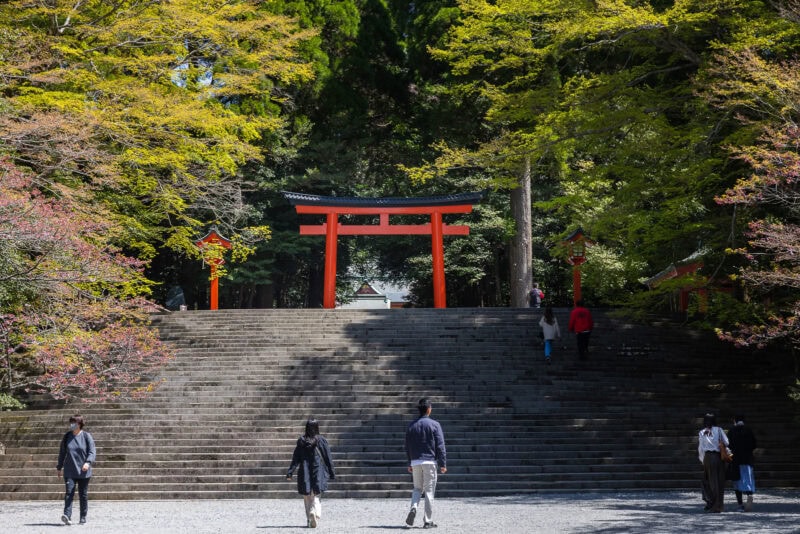
Kirishima Jingu (霧島神宮) sits on the hillside of Mount Kirishima, facing the summit of Mount Takachiho in southern Kagoshima Prefecture. The original structure dates back to the sixth century, built at the foot of Mount Takachiho, but volcanic eruptions destroyed it repeatedly until the current building was relocated and rebuilt in 1715.
It has since been designated a National Important Cultural Property and is considered one of the most important shrines in Japan. On the surface, it may resemble other large Shinto shrines, but understanding its mythology changes how the whole place feels.
What Is Kirishima Shrine
Kirishima Shrine is a Shinto shrine that enshrines Ninigi no Mikoto, the grandson of the sun goddess Amaterasu, who is said to have descended from the heavens onto nearby Mount Takachiho and established the lineage leading to Japan’s emperors.
The Kirishima Mountain Range is central to Japanese mythology, and the shrine sits at the heart of that sacred landscape. It is open 24 hours a day with no admission fee and is revered across Japan as a power spot for family safety and career blessings.
My Experience at Kirishima Shrine
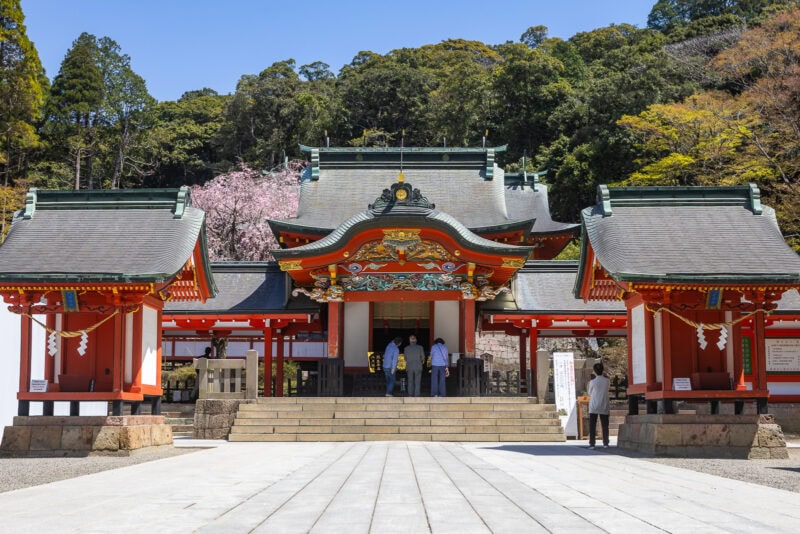
The Kirishima Mountain Range sits at the center of Japan’s creation mythology. According to legend, Ninigi no Mikoto, grandson of the sun goddess Amaterasu, descended from the heavens onto Mount Takachiho carrying the Three Sacred Treasures: the sword, the mirror, and the jewel, which remain the symbols of imperial authority to this day.
He married a local princess, became mortal, and established the lineage that would eventually lead to Japan’s emperors. Visiting the shrine with that story in mind makes the forest, the stone steps, and the ancient trees feel entirely different from a typical shrine visit.
The Approach and the Ancient Cedar
The flight of stone stairs leading to the torii gate sets the tone immediately. The towering cedars on either side close in over the path, and the sound of birdsong and rustling leaves fills the space in a way that makes you instinctively slow down. Along the cedar-lined walkway stands an 800-year-old cedar tree, 38 meters tall with a trunk circumference of 7 meters, said to be the ancestor of all cedar trees in southern Kyushu. It is one of those trees that makes you stop and just look for a moment.
Also beside the path is the sazare-ishi boulder, a rock referenced in the Kimigayo, Japan’s national anthem, as “pebbles that grow into boulders.” Finding it along the path to one of Japan’s most mythologically significant shrines gives it an unexpected resonance.

The Main Hall, Dragon Pillars, and Seasonal Beauty
In front of the main hall stands a pair of ryūbashira, pillars carved with dragons, a distinctive architectural feature of shrines in southern Kyushu. The main hall itself is richly decorated compared to many other Shinto shrines, with deep red lacquerwork and gold detail that reflects the status and reverence the site has held for centuries. The shrine is widely considered a power spot for family safety and career success, which explains the steady stream of visitors from across Japan throughout the year.
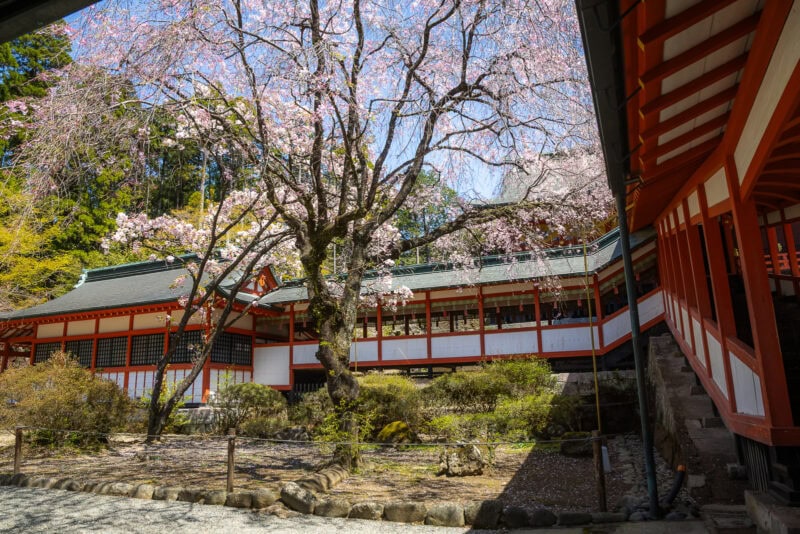
I visited in spring, and the cherry blossoms across the grounds made an already beautiful setting feel exceptional. The area is equally popular in autumn when the surrounding mountain foliage turns red and gold. Behind the shrine, a hiking trail leads to Takachihogawara, the original sixth-century site of the shrine before the volcanic eruptions destroyed it, which offers a deeper connection to the ancient roots of the place for those willing to make the walk.

Andy’s Travel Tips
These simple tips will help you when you visit.
- Read about the mythology before you go. Knowing the legend of Ninigi no Mikoto’s descent onto Mount Takachiho transforms the experience from a beautiful shrine visit into something with genuine historical and cultural depth.
- Walk slowly along the cedar approach and look for the 800-year-old cedar tree and the sazare-ishi boulder. Both are easy to walk past if you are not looking, and both add to the meaning of the visit.
- Visit in spring for cherry blossoms or autumn for foliage. Both seasons make the mountain setting significantly more dramatic, and the shrine is photogenic in either.
- Take the hiking trail behind the shrine to Takachihogawara if you have the time and energy. It leads to the original sixth-century shrine site and adds a deeper layer to the visit for anyone interested in the shrine’s full history.
- Rent a car if possible. The shrine is over 5 kilometers from Kirishima Jingu Station, and while a local bus covers the route, a car gives you the flexibility to explore the wider Kirishima mountain area at your own pace.
- The shrine is open 24 hours and free to enter, so an early morning visit in the cedar forest before other visitors arrive is well worth considering.
How to Get to Kirishima Shrine
Train
The nearest rail hub is Kirishima-Jingu Station, which is on the JR Nippo Main Line.
- From Kagoshima-Chuo Station, take the Limited Express Kirishima train. The ride takes about 50 minutes.
- From Miyazaki Station, the Limited Express Kirishima takes approximately 1 hour and 20 minutes.
- Once you arrive at Kirishima-Jingu Station, the shrine is still about 6 kilometers away. You will need to transfer to a bus or take a taxi to reach the actual shrine grounds.
Bus
- From Kirishima-Jingu Station, board a Kagoshima Kotsu Bus bound for Kirishima Iwasaki Hotel. Get off at the Kirishima-Jingu stop. The bus ride takes about 10 to 15 minutes.
- Please note that buses are infrequent, usually running only once every hour or two, so checking the timetable upon arrival at the station is essential.
Car
Driving is the most flexible way to visit, especially if you plan to explore the nearby Kirishima-Kinkowan National Park.
- From Kagoshima City, the drive takes about 1 hour and 15 minutes via the Kyushu Expressway (exit at Mizobe-Kagoshima-kūko IC).
- From Kagoshima Airport, it is a direct 35 to 40-minute drive.
- There is a large, free parking lot located right at the entrance to the shrine.
Taxi
- A taxi from Kirishima-Jingu Station to the shrine takes about 10 minutes. The fare is typically around ¥2,000 to ¥2,500. This is a great backup if you just missed the hourly bus.
Is Kirishima Shrine Worth Visiting?
Yes, and it is one of the shrines in Japan where the context genuinely elevates the experience. The setting in the Kirishima mountains is beautiful on its own, but the mythology connecting this landscape to the origins of the imperial lineage gives it a significance that most shrines simply cannot match.
It is free, open at all hours, and the cedar forest approach alone is worth the drive. If you are in Kagoshima with any interest in Japanese history or mythology, Kirishima Shrine belongs near the top of your list.
More to Explore Nearby
Kirishima Shrine sits amid the volcanic highlands of southern Kyushu, with Kagoshima city’s rich samurai history and the wild landscapes of Yakushima island both within easy reach.
- Kurokawa Onsen — A couple of hours north, this intimate hot spring village tucked into a forested gorge is one of Kyushu’s most beloved onsen escapes.
- Sengan-en — The Shimadzu clan’s stunning seaside villa garden in Kagoshima city, framed by Sakurajima volcano across the bay. One of Kyushu’s most scenic historic estates.
- Saigo Takamori Legacy — Kagoshima is the birthplace of Japan’s most celebrated samurai, and the city wears that history proudly. A fascinating stop for anyone interested in the Meiji Restoration.
- Yakushima Getting Around — A ferry from Kagoshima port opens up one of Japan’s most extraordinary islands, covered in ancient cedar forests that inspired Studio Ghibli’s Princess Mononoke.