
This post may contain affiliate links. Please read our disclosure policy.
Imbe is a small town in Okayama where centuries-old kilns, rustic streets, and hands-on workshops bring Bizen Ware to life for visitors.

What Makes Bizen Ware Special
Bizen Ware (Bizen-yaki 備前焼) is one of Japan’s oldest ceramic traditions, dating back nearly 1,000 years. It’s made from high-iron clay found in the local area and is known for its reddish-brown tones and unglazed finish. Instead of applying glaze, potters fire the clay in pinewood kilns for 8 to 20 days at extreme temperatures. The long firing process creates natural ash patterns, streaks, and textures that make each piece one of a kind.
Here are some of the most common styles you’ll notice:
- Hidasuki: Wrapped with straw that leaves striking red lines after firing.
- Goma: Flecks that resemble sesame seeds, created by falling pine ash.
- Sangiri: Blue-grey patches that form when pieces sit in cooler parts of the kiln.
Bizen Ware feels earthy and substantial, and one of its charms is how it changes with use. Over time, the surface develops richer tones, almost as if the pottery is alive.
We had several pieces of Bizen ware at home and couldn’t wait to learn about their history and how they’re created.
A Brief History of Bizen Pottery
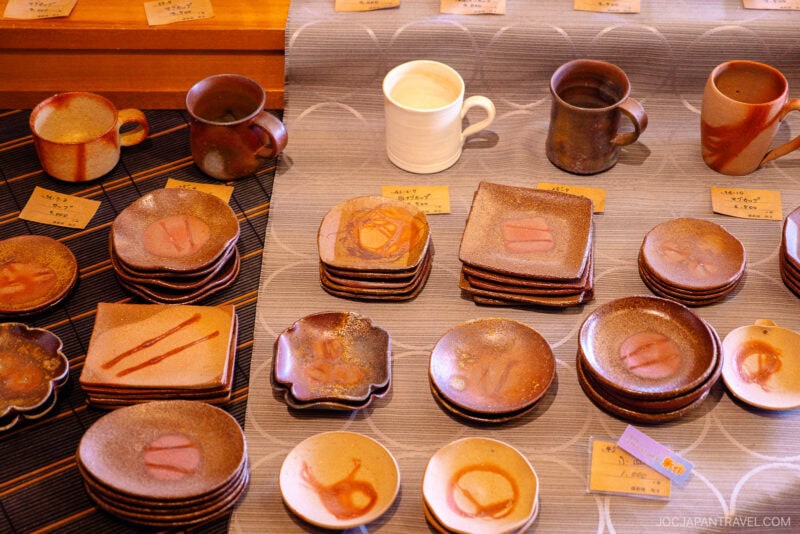
The origins of Bizen-yaki trace back to the Kamakura period (1185–1333), when it was valued for its durability and water retention. Unlike the delicate porcelain of the Heian era, Bizen Ware was practical and meant for everyday life.
By the Meiji period, porcelain and Western goods had overshadowed it, but artisans revived the craft after WWII. Kaneshige Toyo, who later became a Living National Treasure, played a major role in this renewal. Today, Bizen Ware is recognized as one of Japan’s six ancient kiln traditions, and Imbe remains the center of its production.
Exploring Imbe’s Pottery Streets
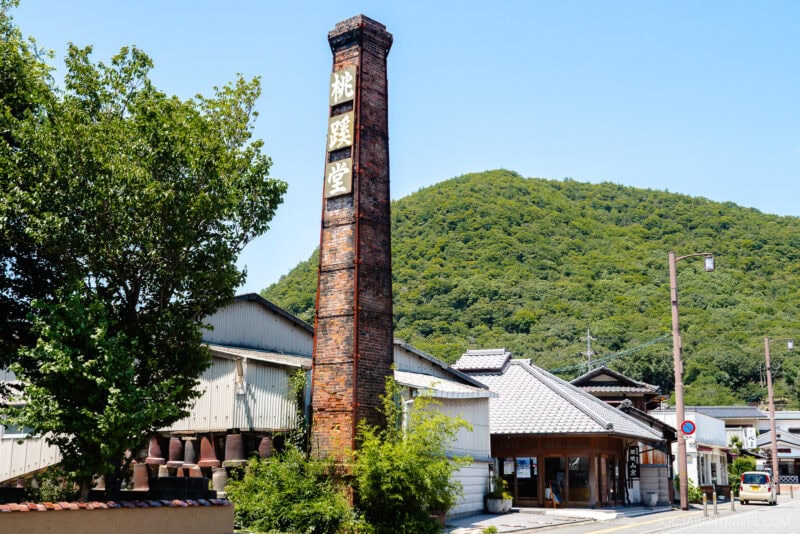
Most Bizen kilns and studios are clustered around Imbe Station, about an hour from Okayama. Not far from the station, we could see brick chimneys, clay walls, and pottery-lined streets. Many shops were filled with handcrafted wares, from tea cups and sake sets to large vases.
Workshops often welcome visitors to try hand-shaping clay or decorating simple pieces. These classes are a fun way to connect with the craft and bring home something personal. We visited the previous Bizen Pottery Museum, which was completely renovated and reopened in July 2025.
The Historic Tempo Kiln

One of the highlights of Imbe is the Tempo Kiln, built in the early 1800s. Though partially in ruins, its stone foundations and preserved structures reveal how Bizen Ware was once fired on a large scale. The kiln stands as a reminder of the community’s long relationship with pottery and is well worth the short walk from the station.
A Simple Lunch at Futaba Shokudo
We took a break from browsing pottery shops at Futaba Shokudo, a small eatery near the station. The menu was straightforward—yaki-udon, buta kimchi, okonomiyaki—and the food was hearty and satisfying. It felt like the kind of diner that locals rely on, a nice contrast to the artistry we’d been admiring.
Don’t Miss the Bizen-yaki Festival
If you’re visiting in October, try to catch the Bizen-yaki Festival. Local potters line the streets with stalls offering discounted wares, live demonstrations, and plenty of food. It’s a lively way to experience the tradition and perhaps take home a special piece at a great price.
How to Get to Imbe (伊部)
By Train
From Okayama Station, take the JR Ako Line to Imbe Station. The ride takes about 1 hour on a local train. From Himeji, ride the JR Sanyo Line to Aioi, transfer to the JR Ako Line, and continue to Imbe. Total time is about 1 hour 45 minutes to 2 hours.
- Okayama Station → Imbe Station on JR Ako Line
- Himeji Station → Aioi on JR Sanyo Line, then JR Ako Line → Imbe Station
- Imbe Station → pottery streets and Tempo Kiln in 5–10 minutes on foot
By Car
From Okayama City, take Route 2 east, then local roads toward Imbe. About 35 minutes. Parking is available near Imbe Station and along the main pottery streets.
On Foot
From Imbe Station, the pottery district, Bizen Pottery Museum, and Tempo Kiln are within a short walk.
Pro Tip: JR Ako Line trains run less frequently outside peak hours. Check return times before you start shopping.
Is Imbe Worth Visiting?

For anyone who loves Japanese ceramics or enjoys cultural experiences away from the crowds, Imbe is a rewarding stop in Okayama. The quiet streets, hands-on workshops, and centuries of craft tradition made our visit unforgettable. Even if you aren’t a collector, you’ll leave with a deeper appreciation for Bizen Ware and the people who continue to create it.
More to Explore Nearby
The ancient kiln tradition of Imbe is perfectly situated near Okayama’s historical and natural treasures, providing easy access to Japan’s oldest school, major ferry ports, and world-renowned art islands.
- Shizutani School – Visit the oldest public school in Japan, a beautiful historical site established in the 17th century that features distinctive Bizenware tiles.
- Uno Port – Head south to this bustling ferry terminal, which serves as the primary gateway from Honshu to the famous art islands in the Seto Inland Sea.
- Naoshima Art Island – Take a short ferry trip to this world-renowned island, famous for its unique blend of contemporary art, stunning architecture, and coastal scenery.
- Shodoshima Island – Explore the Seto Inland Sea’s second largest island, known for its Mediterranean climate, olive groves, and the famous Kankakei Gorge.