This post may contain affiliate links. Please read our disclosure policy.
Step into the Kutaniyaki Kiln Museum in Yamashiro Onsen, where a preserved climbing kiln and exhibits reveal the history of Ishikawa’s world-famous Kutani porcelain.

Exploring the Origins of Kutani Ware
During our stay in Yamashiro Onsen, we were particularly excited to visit the Kutaniyaki Kiln Museum. After a morning soak at the onsen, we drove a few minutes from the town center to see the birthplace of Kutani porcelain.
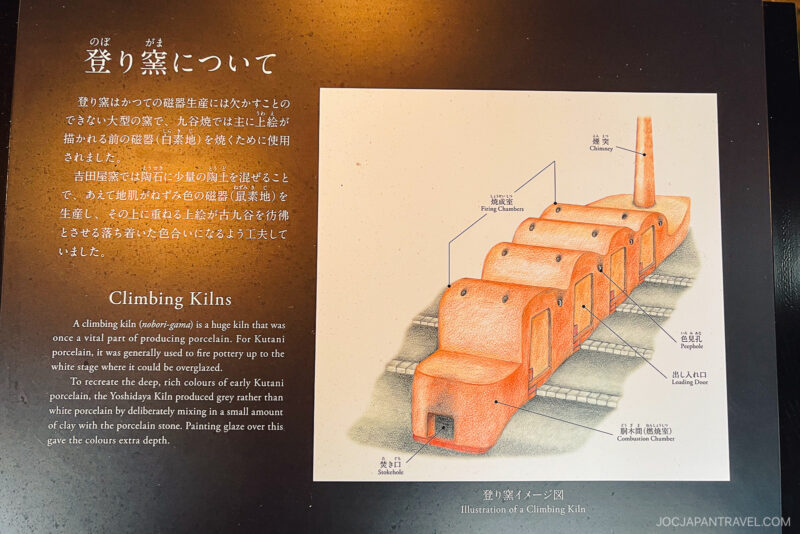
The museum preserves a large climbing kiln (noborigama) that operated for more than a century. Standing inside the restored chambers gave us a real sense of the scale and effort involved in traditional pottery production.
A Brief History of Kutani Ware

Kutani-yaki (九谷焼) first appeared in 1655 in the Kutani area of Ishikawa Prefecture. The style became famous for its bold use of color and detailed brushwork. Production mysteriously stopped in the early 1700s, only to be revived more than 100 years later.
The kiln that now houses the museum was built in 1826 and ran until 1940. A second, smaller kiln nearby continued firing until 1965. These sites fueled the rebirth of Kutani ware and helped establish it as one of Japan’s most admired porcelain traditions. Today, the complex, including the kilns, workshop, and surrounding grounds, is a designated National Historic Site.
What You’ll See at the Museum

Although modest in size, the museum is full of fascinating details:
- Climbing Kiln (Noborigama): Walking above the kiln’s brick chambers on platforms to see how it works.
- Former Kiln Master’s Workshop: Now used as an exhibition hall, this space displays historic tools, unfinished pottery, and examples of Kutani ware across the centuries.
- Interactive Corner: Depending on the season, visitors can try hands-on activities like pottery painting.
- Educational Displays: Multilingual panels clearly explain the origins, decline, and revival of Kutani ware, making the history easy to follow.
The museum isn’t flashy, but the quiet atmosphere and authenticity made it one of our most memorable cultural stops in Yamashiro, where we learn more about Kutani ware’s history.
How to Get to the Kutaniyaki Kiln Museum
On Foot
The museum sits in central Yamashiro Onsen. It’s about 5–10 minutes on foot from the Kosoyu bathhouse area.
By Train
Ride JR to Kaga Onsen Station. From Kanazawa, the limited express takes about 26 minutes.
By Local Bus
- CANBUS sightseeing loop: about 10 minutes to stop 6a “Ancient Kutani Kiln Exhibition Center,” then walk 2 minutes.
By Taxi and Car
About 10 minutes from JR Kaga Onsen Station.
Pro Tip: If you plan to visit multiple Kaga sights, use the CANBUS day pass and pair the museum with Natadera Temple or Yunokuni no Mori.
Is the Kutaniyaki Kiln Museum Worth Visiting?
If you enjoy Japanese crafts, history, or ceramics, this museum is well worth your time. It offers a rare chance to step inside a preserved kiln and learn about the rebirth of Kutani ware. The exhibits add cultural depth to a stay in Yamashiro Onsen and help you appreciate the porcelain you’ll see in local shops and galleries.
More to Explore Nearby
The Kutaniyaki Kiln Museum (九谷焼窯跡展示館) is a historical site dedicated to the beautiful and colorful Kutani porcelain, located near the Yamashiro Onsen area in Kaga. After exploring the roots of this traditional craft, the surrounding region offers more opportunities for cultural immersion, relaxation, and nature.
- Yamashiro Onsen – This is the traditional hot spring town closest to the museum, famous for its historic public bath (Soyu) and preserved streetscapes, offering a relaxing end to your cultural day.
- Yunokuni no Mori – Visit this expansive nearby craft village to participate in hands-on workshops for various local arts, including Kutani ceramics, Wajima lacquerware, and gold leaf.
- Natadera Temple – Discover this unique and ancient Buddhist temple, famous for its dramatic architecture built directly into natural rock caves, offering a spiritual experience and beautiful seasonal views.
- Kenroku-en Garden – While a bit further north in Kanazawa, this is one of Japan’s Three Great Gardens and is a must-see for its exquisite landscape design and seasonal beauty, pairing well with the elegance of Kutani ware.