This post may contain affiliate links. Please read our disclosure policy.
South of Miyazaki City lies one of the prefecture’s most beautiful power spots. Subtropical palms, a romance shrine, and one of Japan’s most unusual rock formations are all found here. Together, they make Aoshima Island a must-visit on any Miyazaki itinerary.
Aoshima Island (青島) is a small subtropical island just off the southern coast of Miyazaki Prefecture, formed by the accumulation of shells on an uplifted seabed around 7 million years ago. The entire island, just 1.5 kilometers in circumference, is considered a shrine precinct, home to more than 200 species, including 27 tropical and subtropical plants, one of Japan’s most distinctive rock formations, and a shrine.
I have been here twice. Despite being in Kyushu, it always feels more like walking along the beaches of Okinawa. It feels unlike anywhere else on the mainland. It should be one of the first things on your Miyazaki itinerary.
What is Aoshima Island
Aoshima Island is a small subtropical island connected to the Miyazaki coast by the 150-meter Yayoi Bridge. The entire island forms the precinct of Aoshima Shrine. The shrine is dedicated to the deities of love and marriage. This makes it one of the most visited romantic power spots in Kyushu.
The island is surrounded by the Devil’s Washboard. It is a nationally designated natural monument of jagged rock formations. They stretch eight kilometers along the coastline. The island is free to enter and open from 6:00 to sunset. Shrine shops operate from 8:00 to 17:30.
My Experience at Aoshima Island
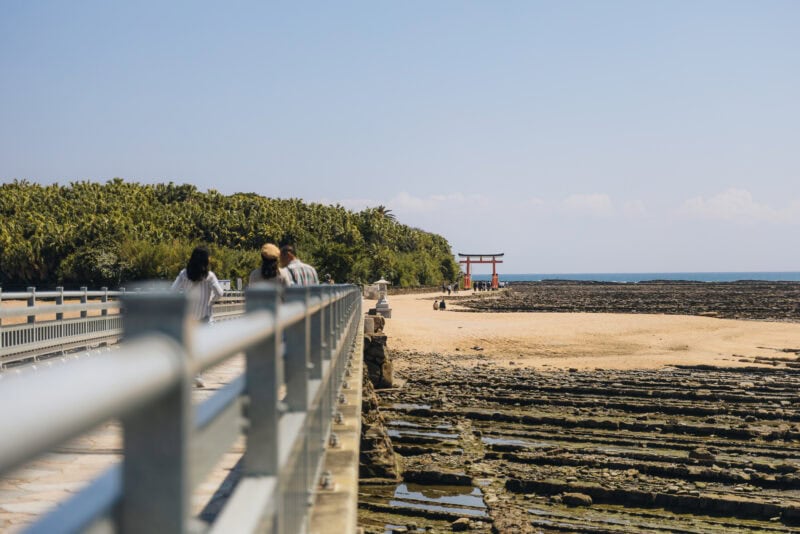
The first thing that stands out as you cross the Yayoi Bridge onto the island is the vermilion torii gate standing directly on the sandy beach, framed by tropical palms. It’s an unusual sight, especially for a shrine, but one that builds anticipation. Once you step onto the island, it feels as if you’re on a tropical island somewhere in Okinawa.
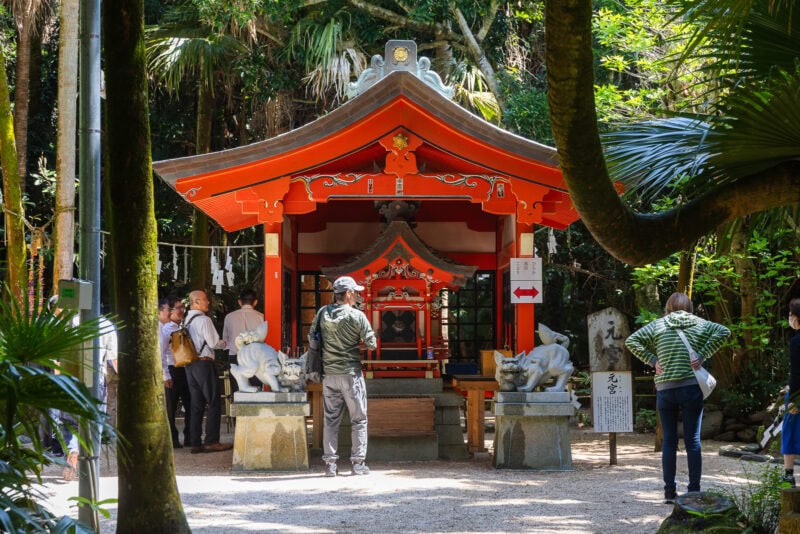
Aoshima Shrine and Moto-miya
Aoshima Shrine is dedicated to Hoori-no-mikoto, his wife Toyotama-hime, and Shiotsuchi-no-kami, the couple’s matchmaker. It is revered as a power spot for romance and draws couples and those hoping to find a partner from across Japan.
Beyond the main shrine, a small tunnel of ema wooden wishing tablets leads through the tropical trees. It opens onto Moto-miya, a smaller inner shrine. Rituals are said to have been held here since the Yayoi period (300 BCE to 300 CE).

Moto-miya has three distinctive features worth engaging with. Behind the shrine is a designated throwing area where you can purchase a bowl, make a wish, and hurl it into the sacred space. If it breaks, your wish is said to come true. A small plinth with a mound of seashells invites you to bring a shell from the beach at the shrine entrance and offer it to the wavy rock with your thoughts and wishes.
Finally, the trees around the shrine are wrapped in colorful strings, a tradition dating back to the Edo Period, when people tied twisted paper to sacred trees to pray for their ideal partner. You can purchase a string and tie it to the designated spot to add your own wish to the collection.
The Devil’s Washboard
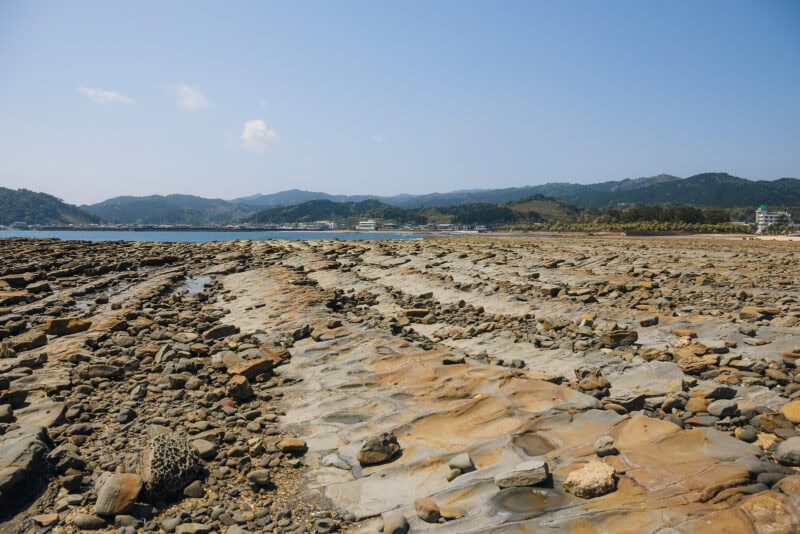
Surrounding the island is the Devil’s Washboard (鬼の洗濯板). This geological formation of jagged, ridged rocks was shaped by millions of years of erosion. Stretching eight kilometers along the coastline, the formation was designated a national natural monument in 1934. Today, it remains one of the most visually distinctive natural features in Miyazaki.
The contrast between the black ridged rock and the cobalt-blue water is striking. At low tide you can walk out over the formation. Natural pools form between the ridges, where starfish and crabs are easy to spot. The footing can be uneven, so take it carefully around the pools and ledges.
Aoshima Beach Park and the Yellow Post Box
On the beach just before the bridge to the island is Aoshima Beach Park. It is a pleasant spot to decompress after exploring. You can stop here for a drink, ice cream, or a light snack. A post box here has been painted yellow in recognition of the shrine’s deities of love. You can actually send letters from it.
The surrounding Aoshima coastline is also a well-established spot for marine sports. Surfing, sea kayaking, and stand-up paddleboarding are all available in the area.


Andy’s Travel Tips
These simple tips will help you when you visit.
- Visit at low tide to walk the Devil’s Washboard. The natural pools between the ridges are the best part of the rock formation up close, but the footing is uneven so wear shoes with grip and take your time around the ledges.
- Pick up a shell from the beach at the shrine entrance before crossing to the island. You will need one to make an offering at the seashell plinth near Moto-miya, and shells from the nearby beach are the traditional choice.
- Try the bowl-throwing ritual at Moto-miya. Make your wish before you throw. If it breaks, the wish is said to come true. It is one of the more memorable shrine rituals in Kyushu.
- Do not drive to the island. Cars cannot access it, and parking on the island is not available. Use one of the coin parking lots near the Yayoi Bridge entrance.
- Send a letter from the Yellow Post Box at Aoshima Beach Park before you leave. It is a small thing, but a genuinely charming detail that fits the romantic character of the whole island.
- Combine with Udo Shrine and Sun Messe Nichinan if you are traveling south along the Nichinan Coast. All three are accessible by the JR Nichinan Line and make for a satisfying full-day itinerary along one of Miyazaki’s most scenic stretches of coastline.
How to Get to Aoshima Island
Train
The island is easily accessible via a short walk from the nearest local station.
- From Miyazaki Station, take the JR Nichinan Line to Aoshima Station. The scenic train ride takes about 30 minutes. From the station, it is a flat, easy 10-minute walk down to the beach and across the footbridge to the island.
Car
Driving is highly convenient and allows you to easily transition onto the Nichinan Phoenix Road to head further south.
- From Miyazaki City center, head south on Route 220. The drive takes approximately 25 to 30 minutes.
- Parking: While vehicles are forbidden on the island itself, there are plenty of coin-operated and private paid parking lots situated right along the mainland beach area.
Is Aoshima Island Worth Visiting?
Without hesitation. Aoshima is one of those places that is hard to compare to because there’s nothing quite like it in Japan. The shrine rituals are interactive and memorable, the Devil’s Washboard is unlike any rock formation I have seen elsewhere in Japan, and the subtropical atmosphere makes it feel like a completely different part of the country.
It is free, a short train ride from Miyazaki City, and easy to combine with the rest of the Nichinan Coast. I have been twice and would go again.
More to Explore Nearby
More to Explore Nearby
Aoshima Island lies at the center of Miyazaki’s stunning Nichinan Coast. The region is packed with natural beauty, sacred sites, and unique coastal attractions.
- Udo Shrine — A sacred cave shrine perched dramatically on the Nichinan cliffs, just a short drive south along the coast.
- Sun Messe Nichinan — A clifftop park famous for its replica Easter Island moai statues and panoramic Pacific views.
- Miyazaki Shrine — Miyazaki’s most important shrine, set within a serene forested precinct in the heart of the city.
- Kirishima Shrine — One of Kyushu’s most atmospheric sacred sites, nestled among volcanic peaks on the Kagoshima-Miyazaki border.
- Sogi Falls — Known as the “Niagara of Japan,” this wide and powerful waterfall is a striking natural highlight of southern Kyushu.