This post may contain affiliate links. Please read our disclosure policy.
Discover the top spots to view stunning cherry blossoms in the Tohoku region. From famous parks to hidden gems, this comprehensive guide covers it all.
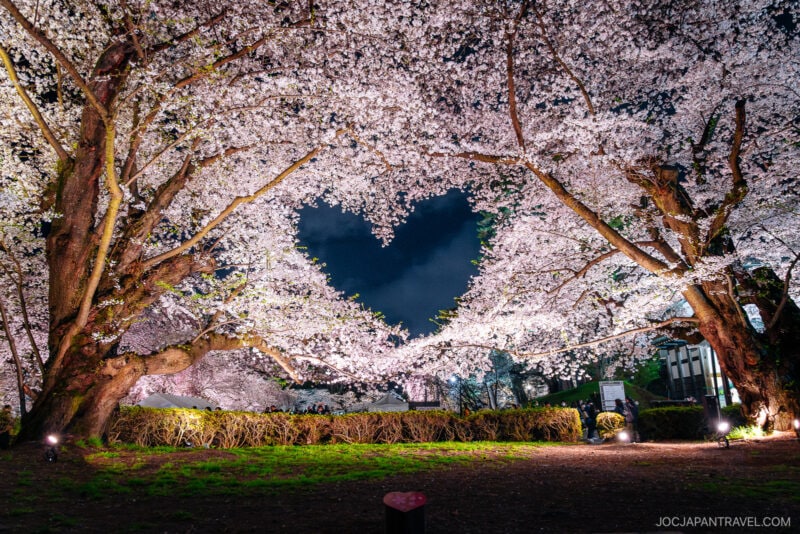
Compared to southern Japan, Tohoku often flies under the radar for many foreign visitors. Yet this northern region boasts some of the most stunning cherry blossom spots in the country.
With its ancient castles, historic temples, serene lakes, and towering mountains, Tohoku offers a rich and diverse landscape for exploration. The cooler climate means cherry blossoms typically bloom from mid to late April, which makes it an ideal destination if you miss the sakura season elsewhere in Japan.
Fukushima Prefecture
Location 1: Nicchu Line Memorial Walkway (日中線しだれ桜並木)
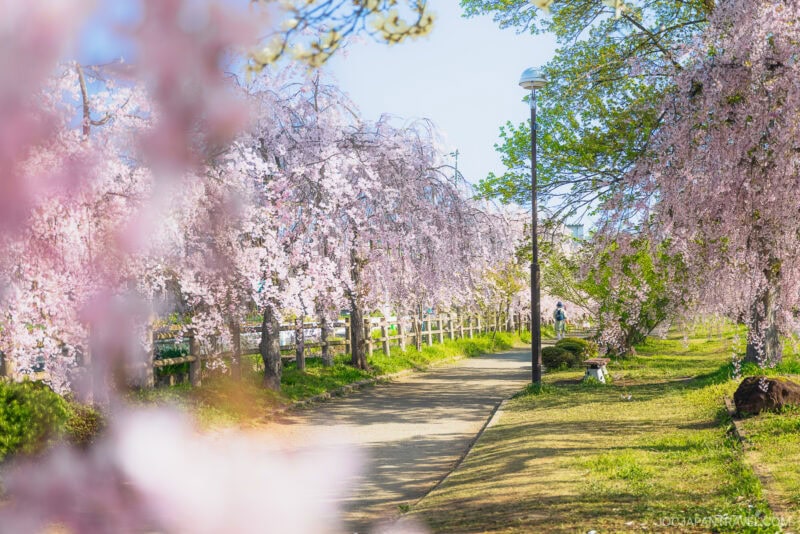
Blossoming Period: Mid-April to late April
Photo Date: April 15, 2024
If there is one cherry blossom spot to visit in Fukushima, this is it. I would rank it alongside the famous Hirosaki Park in Aomori.
The former Nicchu Railway Line, which stretched 13 kilometers between Kitakata City and Atsushio Onsen, has been transformed into a 3-kilometer walking and cycling path lined with over 1,000 weeping cherry trees. Along the way, you’ll find an old steam locomotive that once ran the line. During peak bloom, food stalls offer classic Japanese street food, adding to the festive atmosphere.
Sections of the northern pathway feel completely immersed in pink. The tunnel of blossoms stretches as far as the eye can see, creating one of the most breathtaking hanami experiences I have ever encountered.
Location 2: Hanamiyama Park (花見山公園)
Blossoming Period: Mid-April to late April
Photo Date: April 11, 2024
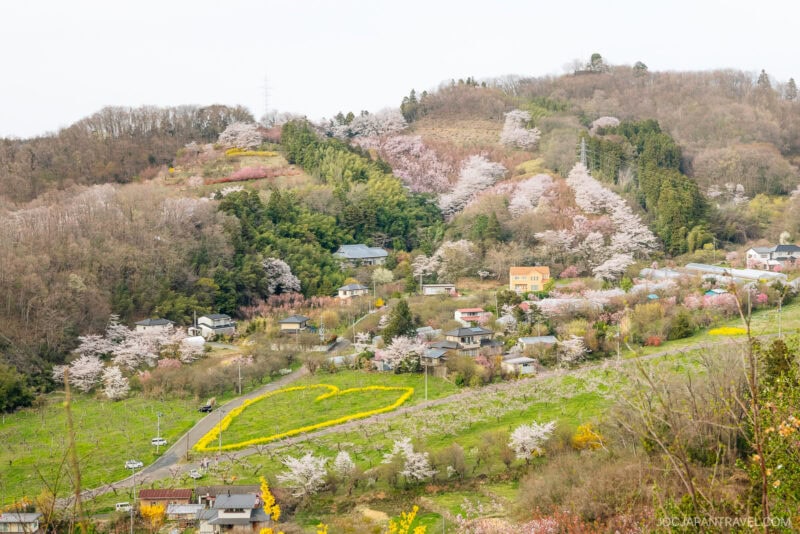
Just outside central Fukushima, Hanamiyama Park sits amidst a quiet farming town. Originally a private park, Ichiro Abe and his father Isejiro cultivated ornamental plants and flowering trees on the hillsides. It opened to the public in 1959 and quickly became one of Fukushima’s top cherry blossom spots.
During peak season, parking near the park can be limited, but dedicated lots and shuttle buses make access easier. A separate shuttle also runs from Fukushima Station for those using public transport.
Here, fields of flowers explode in color, gradually turning into soft pinks up the hillside. Walking trails wind through the park, leading to an observation deck with views of the Azuma Mountains and a vibrant tapestry of spring colors.
Location 3: Tsurugajo City Park (鶴ヶ城公園)
Blossoming Period: Mid April
Photo Date: April 15, 2024
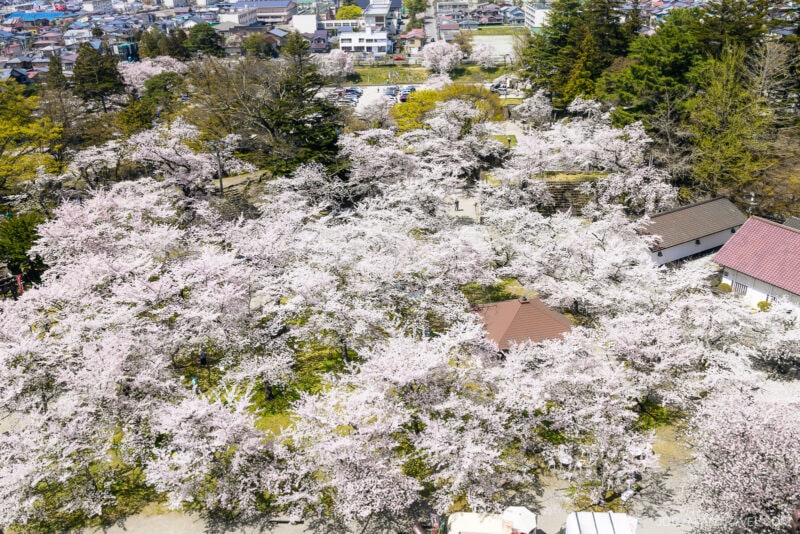
For a combination of history and hanami, Tsurugajo Park is perfect. The park is home to Tsuruga Castle, originally built in 1384. It was a key site during the Boshin War of 1868, which ended Japan’s feudal era. The castle was reconstructed in concrete in the 1960s and now houses exhibits on samurai life and local history.
From the top, you can enjoy panoramic views of the park and the surrounding city. Nearby, the Rinkaku Teahouse offers a serene spot for matcha and wagashi, with a small Japanese garden that reflects the elegance of feudal Japan.
Location 4: Miharu Takizakura (三春滝桜)

Blossoming Period: Mid-April
Photo Date: April 11, 2024
Miharu Takizakura is often considered one of Japan’s most beautiful cherry trees. Its waterfall-like branches cascade in vivid pink, drawing visitors from across the country.
Located in Miharu, the “town of three springs,” cherry, plum, and peach trees bloom in harmony each spring. The Miharu Takizakura stands 12 meters tall, spans roughly 20 meters, and is recognized as a nationally designated Natural Monument.
You can admire the tree from a distance or up close to appreciate its full splendor. Surrounding food stalls and small cafes offer a perfect way to enjoy snacks while gazing at this living masterpiece.
Miyagi Prefecture
Location 1: Hitome Senbonzakura (白石川堤一目千本桜)

Blossoming Period: Early April to mid April
Photo Date: April 10, 2024
Just a 45-minute train ride southwest of Sendai is one of Tohoku’s most famous cherry blossom spots, known as the “View of a Thousand Cherry Trees.” Around 1,200 cherry trees line the Shiroishi Riverside in Ogawara Town, making it Miyagi Prefecture’s top destination in spring.
Start at Funaoka Station and follow the riverside path for five miles (8 km), surrounded by soft pastel hues. Along the way, you’ll spot Somei Yoshino, White Mountain cherry, Double-flowered cherry, Sendai Yoshino, and more. In the distance, the majestic snowy peaks of Mt. Zao create a breathtaking backdrop.
From early to mid-April, the Ogawara Sakura Festival takes place, with food stalls lining the riverbank. In the evening, the blossoms are illuminated, turning the riverside into a romantic pink wonderland.
Location 2: Funaoka Castle Park (船岡城址公園)

Blossoming Period: Mid to late April
Photo Date: April 10, 2024
Halfway along Hitome Senbonzakura is Funaoka Castle Park. A bridge connects the two, giving you sweeping views of the cherry trees and the JR Tohoku Main Line train as it passes between Ogawara and Funaoka Stations.
Once a strong fortress, Funaoka Castle stood proudly until the Meiji Restoration of 1868. Today, a 24-meter concrete Kannon statue stands at the summit, symbolizing peace and protection.
The climb is steep, so comfortable shoes are recommended. Alternatively, you can ride the slope car, which glides through a sea of pink blossoms. At the top, a small shop offers bento boxes and drinks to enjoy amidst the spring scenery. You can admire Hitome Senbonzakura with the backdrop of Mt. Zao from various lookout posts.
Location 3: Tsutsujigaoka Park (榴岡公園)

Blossoming Period: Mid April
Photo Date: April 12, 2024
If you’re staying in Sendai, Tsutsujigaoka Park is an easy and beautiful hanami stop. Home to over 360 cherry trees, the park transforms into a peaceful pink oasis amidst the city. Many locals gather here with picnic blankets, so bring some food and drinks to enjoy under the blooming canopy as the spring breeze rustles the petals.
Nearby, Nishi Park is another popular spot worth mentioning. It features culturally significant monuments, a steam locomotive, sculptures by local artists, and a plum tree brought from Korea 400 years ago by Date Masamune, the first lord of Sendai.
Location 4: Matsushima (松島)

Blossoming Period: Early April to late April
Photo Date: April 14, 2024
Famous as one of the “Three Views of Japan,” Matsushima is known for its 260 pine-covered islands and fresh seafood, especially oysters. While our Matsushima travel guide covers sightseeing in detail, the cherry blossoms here deserve a mention.
After a sightseeing boat tour and a seafood lunch, head to Saigyo Modoshi no Matsu Park. From here, you can admire Matsushima Bay framed by over 250 cherry trees.
Yamagata Prefecture
Location 1: Kajo Park (霞城公園)

Blossoming Period: Mid-April
Photo Date: April 12, 2024
At the heart of Yamagata City, Kajo Park surrounds the historic Yamagata Castle, built in 1592 by Yoshiaki Mogami, one of Tohoku’s most celebrated feudal lords. After World War Two, the castle grounds were transformed into Kajo Park, offering a serene escape in the center of the city.
The 235-hectare park combines history and nature, with cherry blossoms painting the landscape in soft pink and white during spring.
Location 2: Ningen Shogi (人間将棋)

Event Period: Mid-April (event dates change every year)
Photo Date: April 14, 2024
Tendo City hosts the fascinating Ningen Shogi, or Human Japanese Chess, for two days during full bloom. Participants dress in Edo-period attire and play on a 16-meter by 14-meter life-sized shogi board in Tendo Park.
Tendo is Japan’s largest shogi production city and the only place to experience this unique event. The rules are different from Western chess, so it can be difficult to follow. However, the overall performances, scenery, and atmosphere are worth visiting!
Iwate Prefecture
Location 1: Kitakami Tenshochi Park (展勝地公園)

Blooming Period: Mid-April to early May
Photo Date: April 18, 2024
Kitakami Tenshochi Park hosts the Kitakami Tenshochi Cherry Blossom Festival from mid-April to early May. Recognized as one of Japan’s “100 Best Cherry Blossom Spots” and a top three site in the Tohoku region, the park covers over 300 hectares with more than 10,000 trees of over 150 varieties.
From Sango-Bashi Bridge, a two-kilometer tunnel of cherry blossoms stretches along the park. You can walk the path or take a scenic horse ride. During the festival, koinobori (carp streamers) fly above the Kitakami River, and boat cruises offer a unique view from the water.
Location 2: Koiwai Farm (小岩井農場)

Blooming Period: Mid-April to early May
Photo Date: April 21, 2024
Founded in 1891, Koiwai Farm in Morioka is one of Japan’s oldest dairy farms, spanning over 3,000 hectares. Makiba Park, the main visitor area, features wide fields, souvenir shops, restaurants, and seasonal activities like horse riding and archery.
During spring, pockets of cherry blossoms dot the open pastures, with the snowy Mt. Iwate in the background. Nearby, Kamimaru Cowshed houses a small museum, the former head office, and several cowsheds. A solitary cherry tree in the expansive green fields offers a peaceful spot for reflection.
Akita Prefecture

Location 1: Hinokinaigawa Tsutsumi Park & Kakunodate (桧木内川堤公園&角館町)
Blooming Period: Mid-April
Photo Date: April 19, 2024
Kakunodate, often called Tohoku’s “Little Kyoto,” is a historic castle town founded in 1620 in Semboku City. The northern samurai district, Uchimachi, is lined with preserved samurai residences, while the southern town, Tomachi, serves as the modern center.
During the Kakunodate Cherry Blossom Festival, elegant weeping cherry trees steal the spotlight. The dark wooden facades of the samurai houses form a striking contrast with cascading pink and white petals, creating a truly magical scene.
Nearby, Hinokinaigawa Tsutsumi stretches two kilometers along the Hinokinai River, where 400 Yoshino cherry trees line the banks.
After exploring, enjoy Akita’s famed Hinai Jidori, a prized native chicken. I highly recommend visiting Akita Hinai Ya for oyakodon or yakitori. The meat is succulent, full-bodied, and a delicious way to end a day of cherry blossom viewing.
Aomori Prefecture
Location 1: Hirosaki Park (弘前公園)

Blooming Period: Mid-April to late April
Photo Date: April 19, 2024
Hirosaki Park is Aomori’s most famous cherry blossom spot, and it’s widely considered the top sakura destination in Japan. For me, it ranks alongside the Nicchu Line Memorial Walkway as one of Tohoku’s absolute best.
Between April 23 and May 5, over two million visitors flock to the Hirosaki Cherry Blossom Festival to admire 2,600 trees of more than 50 varieties, some over 300 years old. The spacious grounds, food stalls, Hirosaki Castle, and surrounding moats provide endless opportunities to enjoy the blossoms.
Be sure to explore the cherry blossom tunnel, and consider renting a boat at the western moat for a scenic water view. Look closely, there’s even a heart-shaped cut among the branches!
As evening falls, the petals reflect in the water, creating a magical, otherworldly scene. A short walk to the edge of the moat gives you a view of the red bridge framed by the illuminated blossoms. This is a sight no photo can fully capture. Even just after full bloom, the fallen petals turn the moats into a soft pink carpet, making it just as enchanting.
Location 2: Ashino Park (芦野公園)

Blooming Period: Mid-April to late April
Photo Date: April 20, 2024
Ashino Park is the northernmost cherry blossom spot on this list, part of the Ashino Chishogun Prefectural Natural Park, which also includes Lake Ashinoko. The park is home to 1,500 cherry trees and 1,800 pine trees.
The highlight is the cherry blossom festival, typically held from April 29 to May 7. One of the most photographed scenes is the local train passing through a tunnel of cherry blossoms. It attracts photographers and visitors alike, so it can get busy, but it’s worth the experience.
Finish your trip in Aomori with a Nokke-Don at the Aomori Gyosai Center. This customizable seafood bowl lets you handpick your favorite ingredients, salmon, tuna, scallops, sea urchin, and more on a fresh bed of rice. It’s a perfect, delicious way to wrap up your hanami adventure.
Wrapping Up: Cherry Blossoms in Tohoku
If you find yourself arriving late to cherry blossom season, heading north to Tohoku is a fantastic option. The spots highlighted in this guide are among the region’s most beloved, but countless smaller, hidden pockets of blossoms await discovery.
More inspiration on cherry blossoms across Japan
- The Best Spots for Tokyo’s Cherry Blossoms
- Nara Cherry Blossoms – 9 Best Viewing Spots
- Kanazawa Cherry Blossom Viewing Guide
More to Explore Nearby
The Tohoku Region is a vast and spectacular area, famed for its deep historical roots, rugged coastlines, and pristine mountains. After enjoying the breathtaking cherry blossoms, the region offers world-class scenic, historical, and cultural experiences that are essential parts of any Tohoku journey.
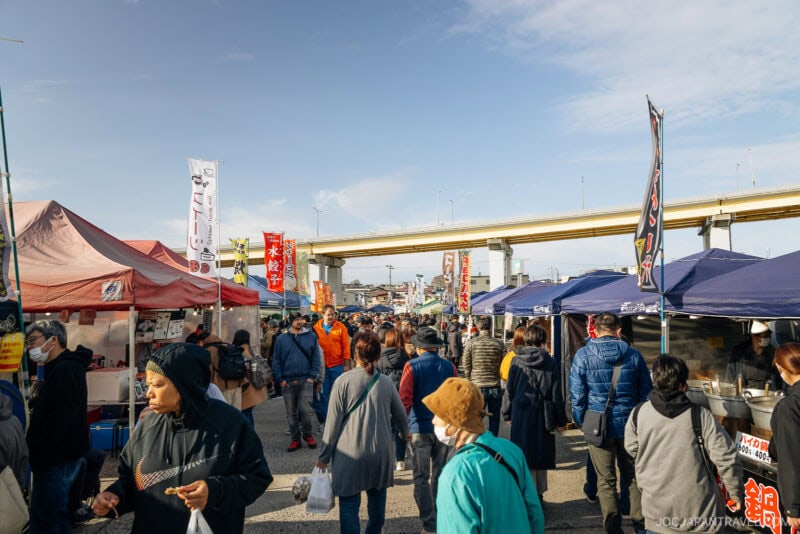
- Hachinohe Morning Market is the only orphan in the pool, zero inbound links from anywhere on the site. This is the orphan-priority rule doing its job, and Aomori is where your two best spots already are.
- Matsushima Travel Guide because your own Miyagi section already links to it in the body, so the connection is established.
- Yamagata Travel Guide covers the prefecture holding Kajo Park and Tendo.
- Sendai Food Guide because Tsutsujigaoka is in Sendai and you tell readers to base themselves there. It also matches the food notes you already close Akita and Aomori with.