

This post may contain affiliate links. Please read our disclosure policy.
Kumano Hongu Taisha, one of the most revered shrines in Japan, reveals a rich history and spiritual significance. Let’s journey through the area to learn about its ancient rituals and stunning architecture that continues to attract visitors seeking enlightenment.
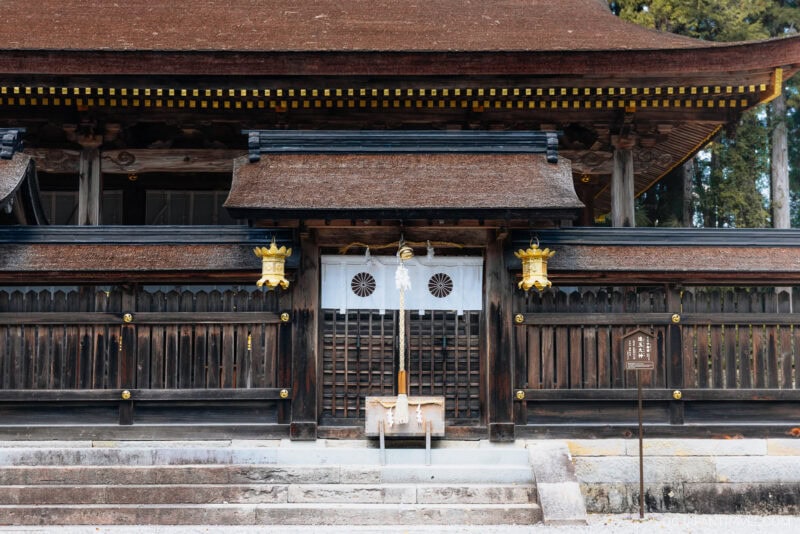
Set amidst the tranquil landscapes of Wakayama Prefecture, Japan, Kumano Hongu Taisha, or the Kumano Grand Shrine, radiates a deep sense of history and spirituality. This sacred Shinto sanctuary is part of the Kumano Sanzan, a trio of grand shrines, and serves as the head of over 3,000 Kumano shrines across Japan. It has long been a central destination for pilgrims traveling the ancient Kumano Kodo pilgrimage routes.
The shrine’s torii gate, the largest in Japan, immediately draws visitors in, inviting them to begin a journey of reflection and discovery.
What is the Kumano Kodo?

For over 1,000 years, the mountainous Kumano region has been revered as the mythical “land of the gods.” During the Heian Era (794–1185), members of the imperial family undertook a challenging journey from Kyoto to this remote area, a pilgrimage that could last over 30 days.
The three grand shrines—Kumano Hongu Taisha, Kumano Nachi Taisha, and Kumano Hayatama Taisha—were established in this region and collectively became known as the Kumano Sanzan.
For centuries, these shrines reflected the combined practices of Shinto and Buddhism, a tradition called Shinbutsu-shugo. This continued until the Meiji government ordered the separation of the two religions in 1868.

The Kumano Kodo, a network of trails connecting the Kumano Sanzan through the Kii mountains, is considered a path of spiritual transformation. Historically, it drew emperors and members of the imperial family.
Travelers from around the world now walk these trails, seeking reflection, peace, and connection. In recognition of its cultural and historical importance, the Kumano Kodo was designated a UNESCO World Heritage site in July 2004 as part of the “Sacred Sites and Pilgrimage Routes in the Kii Mountain Range.”
Getting to Kumano Hongu Taisha
By Bus
Access is possible from three stations, though schedules are limited, so check timetables in advance.
- From Goto Station: Take bus no. 301 to Hongu Taisha-mae. The ride takes about five hours and costs 3,250 yen (2024 prices). (Timetable)
- From Shingu Station: Buses no. 51, 53, 90, or 302 reach Hongu Taisha-mae in about 70 minutes for 1,560 yen. Some buses stop at popular onsen along the way, such as Kawayu, Wataze, and Yunomine. (Timetable)
- From Kii Tanabe Station: Bus no. 81, 85, 91, or 95 will get you to Hongu Taisha-mae in just over two hours, costing 2,100 yen. (Timetable)
By Car
I highly recommend driving in Japan if you’re in a group. Tolls can be high, but sharing costs between 2–4 people makes it reasonable. Driving allows flexibility and offers unforgettable views through the mountains of Kumano.
Kumano Hongu Taisha
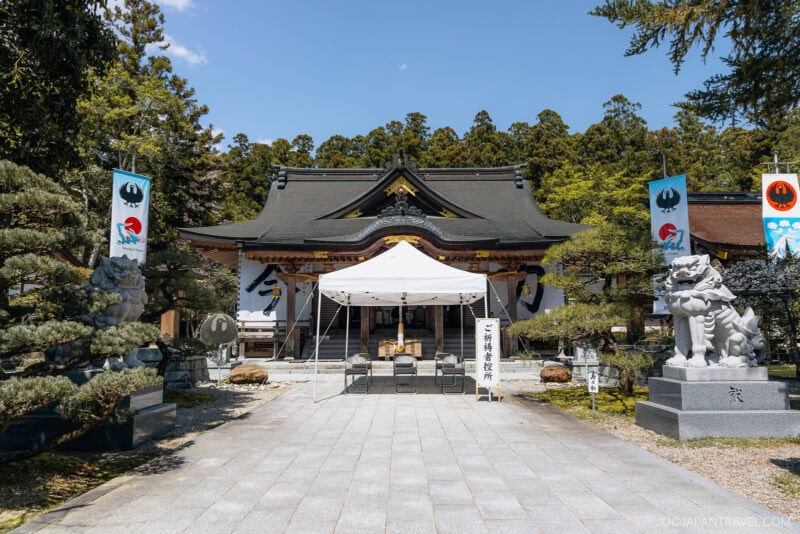
Hidden among towering cypress trees, the entrance to the shrine is marked by the grand torii gate. Passing through it, you feel the weight of centuries, surrounded by fluttering flags and cedar trees that evoke serenity and wonder.
Halfway up the 158 stone steps, purify yourself at the Chozuya water basin under the watchful gaze of Yatagarasu, the three-legged crow. At the top, a shrine shop offers omamori (amulets), omikuji (fortunes), and other treasures. To the left is the shrine office, while directly ahead is the Hiden, where kannushi (Shinto priests) pray on behalf of visitors. Two stone Komainu statues guard the sanctuary from evil spirits.
Read: A Guide to Japan shrines and Temples Etiquette
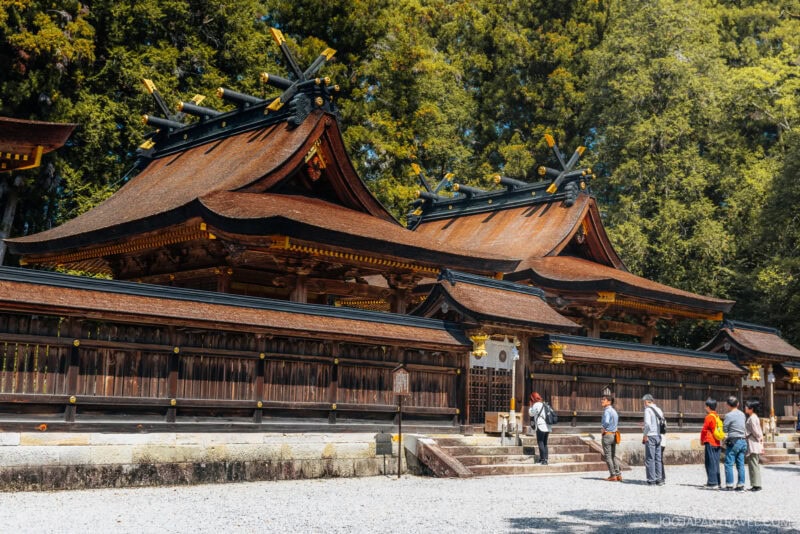
The Honden, or main hall, features stunning architecture with a thatched roof made of cypress shingles. Kumano Hongu Taisha enshrines Izanagi-Okami, who gave birth to Japan, and Ketsumimiko-Okami, who supports humanity. Visitors come to pray for harmony at home, a happy marriage, and a long life.
Spring and Autumn Festivals
Spring Festival (April 13–15): Fathers and sons purify themselves at Yunomine Onsen before walking the Dainichi-goe section of the Kumano Kodo to Oyunohara in traditional attire. Children wear the kanji 大 (“big”) on their foreheads and are carried for the journey. The festival ends with a mikoshi parade, fire rituals, and a mochi scramble.
Yata-no-Hi Fire Festival (August): This celebration honors Yatagarasu, the three-legged crow who guided Emperor Jinmu. A portable shrine adorned with the crow motif is carried from Kumano Hongu Taisha to Oyunohara. The festival features Taiko drumming, traditional dancing, and fireworks.
Dining Nearby
I found a small family-style spot called Kitchen (きっちん) open on a Monday, a day when many shops in Japan close. I had a simple but satisfying udon and mehairzushi (rice ball wrapped in pickled mustard greens). It was a standard meal but tasty enough to keep me fueled for more exploring.
Oyunohara: The Original Kumano Hongu Taisha

Just behind きっちん is Oyunohara (大斎原), the original site of Kumano Hongu Taisha. It sits on the sandbank where the Kumano and Otonashi Rivers meet. In 1889, a great flood destroyed three of the shrine’s structures, leading to the relocation of the remaining buildings to their current site.
Japan’s Largest Torii Gate

The entrance to Oyunohara is marked by Japan’s largest torii gate, soaring 34 meters high. During cherry blossom season, the base is bathed in soft pink hues, creating a magical atmosphere.
The surrounding scenery allows you to appreciate Wakayama’s mountainous beauty and serenity as you embark on your spiritual adventure.
Inside the grounds, a small stone shrine sits among even more cherry blossoms. Despite being in full bloom, almost no one was there, giving me a peaceful time to enjoy hanami (cherry blossom viewing). Strong winds during my visit turned the petals into a sakura fubuki, or cherry blossom snowstorm.
My visit deepened my connection to the timeless traditions of the Kumano region. No matter the season, Kumano Hongu Taisha and Oyunohara are indeed a joy to explore.
More to Explore Nearby
Kumano Hongu Taisha (熊野本宮大社) is one of the three Grand Shrines of Kumano and the historical destination for pilgrims completing the central routes of the Kumano Kodo. After visiting the shrine and the dramatic Ōtorii gate at Oyunohara, the surrounding Kii Peninsula is filled with sacred sites, pilgrimage routes, and opportunities for deep relaxation.
- Oyunohara (大斎原) – Visit the original, former site of Kumano Hongu Taisha, located on a sandbank of the Kumano River. It is marked by the massive, iconic black Ōtorii gate, the largest in the world.
- Kumano Kodo Pilgrimage Routes – Step onto the ancient trails that converge at Hongu. Routes like the Nakahechi and Iseji offer scenic forest hikes and a profound historical journey through the Kii Mountains.
- Nachi Falls and Kumano Nachi Taisha – Visit the eastern Grand Shrine of Kumano, famous for its magnificent setting next to Japan’s tallest single-drop waterfall. This site offers the iconic view of the pagoda and the falls together.
- Kawayu Onsen – Located nearby, this unique onsen is famous for its riverbed hot springs. You can dig your own bath in the river gravel, especially during the winter (Sennin風呂 – Sennin-buro), for a natural hot spring experience.


