This post may contain affiliate links. Please read our disclosure policy.
Leave behind the hot springs of Beppu and Yufuin and venture into Oita’s most cherished and least-visited destination, where ancient temples, sacred mountain paths, and 1,300 years of combined Buddhist and Shinto tradition await on the Kunisaki Peninsula.
The Kunisaki Peninsula (国東半島) sits in the northern part of Oita Prefecture, facing the Seto Inland Sea across a landscape shaped almost entirely by faith. Radiating outward from the central Mount Futago is Rokugo Manzan, a 1,300-year-old tradition that blends Buddhism, Shinto, and mountain worship into a single living culture.
Dotted across the two cities that make up the peninsula, Bungotakada and Kunisaki, are countless temples, shrines, and thousands of stone Buddhas that define the region’s character. I have traveled most of Kyushu, and after visiting for a day trip, there is no other part of Kyushu that feels quite like this.
Table of Contents
- Usa Shrine: Oita’s Most Revered Shrine
- Fukiji: The Oldest Wooden Building in Kyushu
- Futagoji: The Heart of Kunisaki
- Showa-no-machi: A Journey Back in Time
- Koikana Road: Awashimasha Shrine and Matama Beach
- Andy’s Travel Tips
- How to Get to the Kunisaki Peninsula
- Is the Kunisaki Peninsula Worth Visiting?
- Related Posts:
Usa Shrine: Oita’s Most Revered Shrine
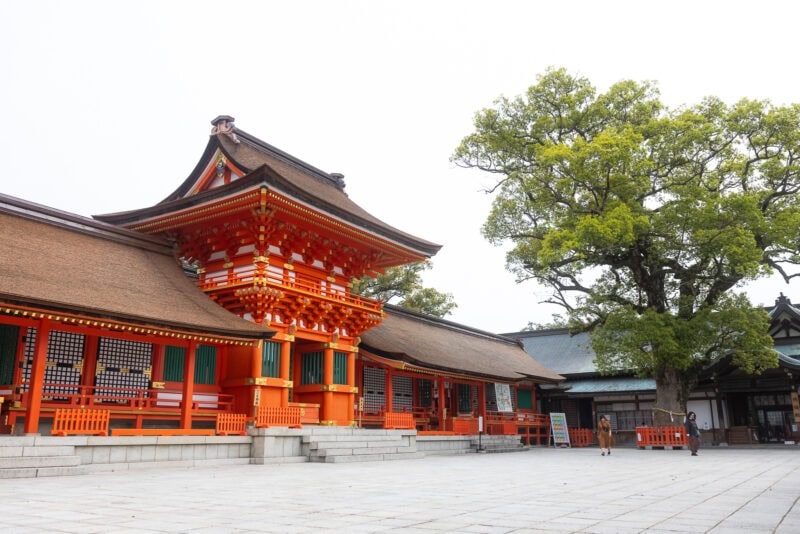
Usa Shrine, or Usa Jingu, is my personal favorite spot on the peninsula and one of the most significant Shinto sites in all of Japan. Built in 725, it is the head shrine of over 40,000 shrines across the country dedicated to Hachiman, the protector of Japan and god of war, and is considered one of the founding points of the Rokugo Manzan tradition. The complex spreads across Mount Ogura with the Upper Main Shrine (Jogu) at the summit and the Lower Main Shrine (Gegu) at the base, connected by a network of ponds, auxiliary shrines, and paths.
The Upper Shrine is a designated national treasure and features three altars, each enshrining its own deity. The left altar honors Hachiman, patron of agriculture, fishing, travel, commerce, learning, and the arts. The central altar enshrines Himeookami, guardian of travelers, communication, and happiness. The right altar is dedicated to Empress Jingu, protector of childbirth and marriage. The treasure hall is accessible from the north and west gates and worth including in your visit.
- Hours: 5:30–19:00 (from 6:00 October to March) | Free admission
Fukiji: The Oldest Wooden Building in Kyushu
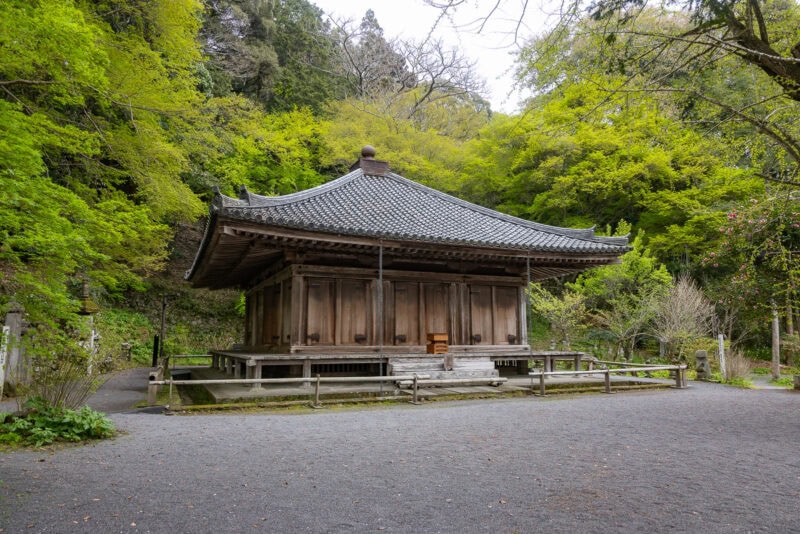
Built in the eighth century, Fukiji Temple is the oldest wooden structure in Kyushu. It is also known as Fukiji Odo. It is one of the “Three Amida Halls” of Japan. The other two are Byodoin Hoo-do in Uji, Kyoto, and Chusonji Konjikido in Hiraizumi, Iwate. It was designated a National Treasure in 2013.
Inside the hall is a seated statue of Amida Nyorai. It was carved from a single tree trunk and is designated an Important Cultural Property. Behind it, a mural depicting the Pure Land has faded and chipped over the centuries. The mandala pattern, however, remains clearly visible. Be sure to explore all the finer details. The pillars are decorated with intricate Buddhas, bodhisattvas, and arabesques.
Surrounding the hall are mossy, towering forests. You can walk through them and absorb the history at your own pace. I visited in spring, but the temple is arguably at its most beautiful in autumn or winter. Golden ginkgo trees and fiery foliage wrap around the ancient hall in those seasons. It makes the already extraordinary setting feel even more impressive.
- Hours: 8:30–16:30 | Admission: 300 yen
Futagoji: The Heart of Kunisaki
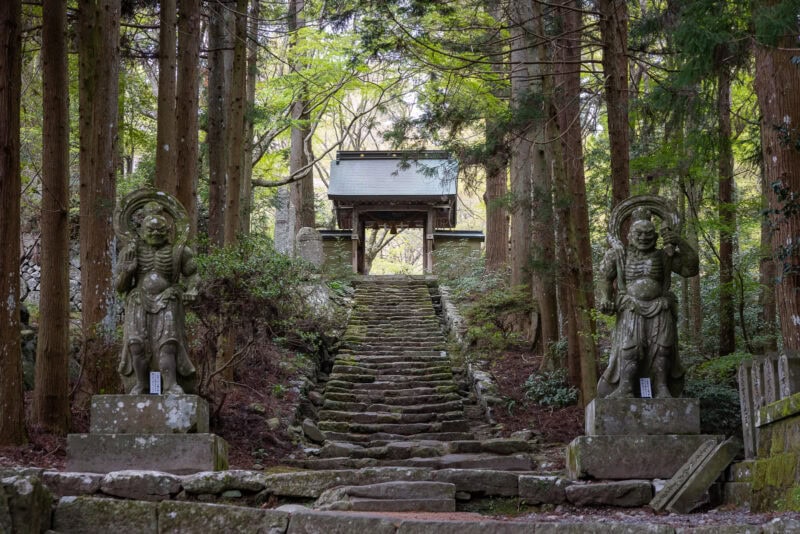
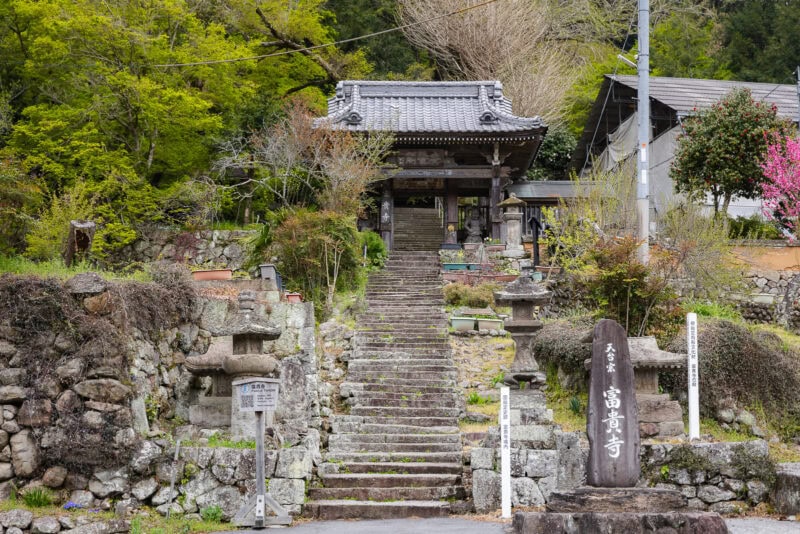
Futagoji Temple (両子寺) sits on the slopes of Mount Futago. It has been the central temple of the Rokugo Manzan region since 718. It was established by the legendary monk Ninmon.
The most immediately striking feature at the entrance is a pair of towering Nio guardian statues. One has its mouth open, representing the sound “Ah.” The other has its mouth closed, representing “Uhm.” In Buddhist belief, “Ah” is the first sound made at birth. “Uhm” is the last sound at death.
Beyond the Nio statues, the forested approach feels like stepping into another world. Gomado Hall, with its elegant blue roofline and bell-shaped windows, was under renovation during my visit, but the path continues through the forest, across a stone bridge over a babbling creek, to Okunoin Hall. The small structure is built directly into the rock face and enshrines the thousand-armed Kannon Bodhisattva. There were only a handful of people around the grounds, which allows you to really appreciate the temple’s history and presence.
- Hours: 8:30–16:30 | Free admission
Showa-no-machi: A Journey Back in Time
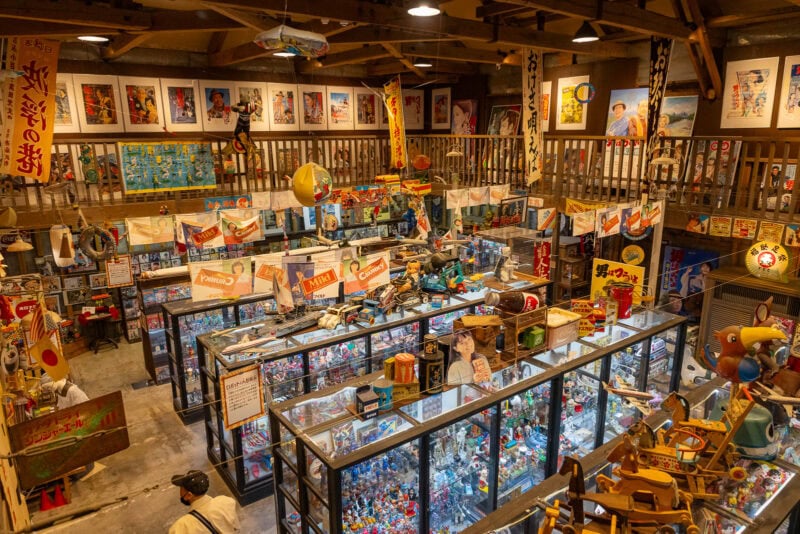
For something completely different, Showa-no-machi is a Showa Era (1926–1989)-themed shopping street. It is located in Bungotakada City. It has been meticulously restored to feel like a mid-20th-century Japanese town.
Retro vehicles, buses, and bicycles line the historic shotengai. The buildings inside have been converted into an elementary school classroom, a sweets shop, and a museum. The sweets shop serves iconic snacks from the era. The museum is packed with Showa-era memorabilia. A recreated traditional Japanese family home sits alongside it.
I did not know much about the Showa period going in. But the retro vehicles, trinkets, and games made it a surprisingly fun detour between the temples.
- Hours: 10:00–17:00 (from 9:00 on weekends) | Street: free admission. 3-museum combination ticket: 1,200 yen adults, 840 yen children.
Koikana Road: Awashimasha Shrine and Matama Beach
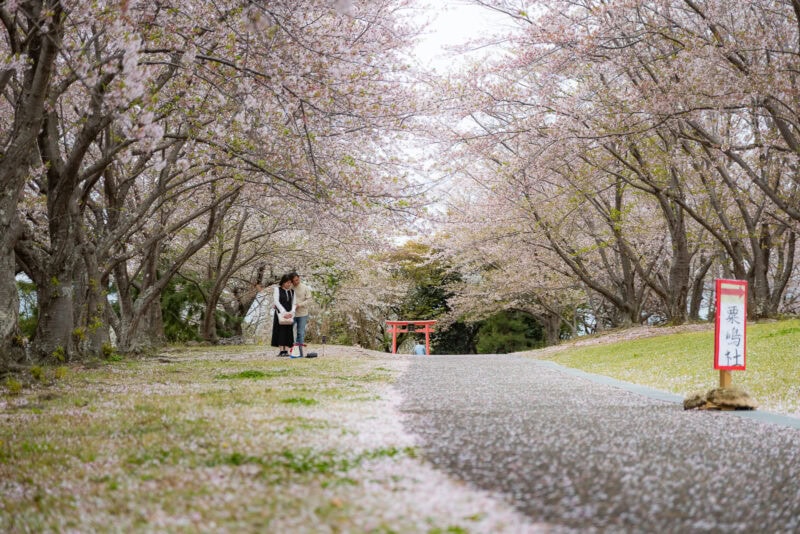
National Route 213 stretches 20 kilometers along the western edge of the peninsula. It is known locally as Koikana Road, or Lovers Road. Along this coastal stretch are two notable stops.
Awashimasha Shrine perches on a clifftop above the ocean. It is said to grant women a single wish. This draws many visitors who come to pray for marriage. I visited during cherry blossom season. The combination of the ocean view, the blossoms, and the clifftop shrine was stunning. It made for one of the most quietly beautiful moments of the whole trip.
Adjacent to the shrine is Matama Beach. It is one of the “100 best sunset spots in Japan.” I was not in the area at the right time for the sunset. But during the day the panoramic coastal views are still impressive. The beach is also popular for tide-pooling for shellfish when the tide is out.
- Hours: Open 24 hours | Free admission

Andy’s Travel Tips
These simple tips will help you when you visit.
- Rent a car from Beppu, Oita City, or Oita Airport. Public transport on the peninsula is infrequent and inconvenient. A car is the only practical way to visit multiple spots in a single day, and the coastal and mountain roads are scenic enough to be part of the experience.
- Consider the guided bus tour if you cannot drive. A daily Japanese-language tour departs from Oita Station, picks up passengers at Beppu and Usa Stations, visits the main sites including Usa Shrine and the key temples, and returns via Oita Airport. It costs 3,500–5,700 yen depending on where you board and alight.
- Visit Fukiji in autumn or winter if your timing allows. The golden ginkgo trees and autumn foliage around the ancient hall make it even more beautiful than spring, and the crowds are typically smaller.
- Time Matama Beach for sunset if your itinerary allows. It was voted one of the 100 best sunset spots in Japan, and driving Koikana Road in the evening light toward the shrine and beach is a very different experience from a midday visit.
- Plan for a full day at minimum. The peninsula rewards slower exploration, and the temples and shrines have enough depth that rushing between them misses most of what makes Kunisaki special.
How to Get to the Kunisaki Peninsula
Driving is highly recommended for Kunisaki. Public transport to the famous mountain temples like Futago-ji or the Kumano Magaibutsu stone carvings is extremely limited and infrequent.
- From Oita Airport: The airport is actually located on the peninsula itself. You can rent a car immediately upon arrival and be at the coastal sites within minutes.
- From Beppu: The drive to the southern edge (Kitsuki) takes about 30 to 40 minutes. Reaching the central mountains takes about 1 hour and 15 minutes.
Bus
- From Beppu Station: You can take the Oita Kotsu bus toward Kunisaki, which takes about 1.5 hours.
- Sightseeing Bus: There is a “Regular Sightseeing Bus” (Teiki Kanko Bus) that departs from Beppu or Oita Station. It is a great one-day option that covers major spots like Usa Shrine, Fukiji Temple, and the Kumano Magaibutsu without needing a car.
Pro Tip If you enjoy hiking, look into the Kunisaki Minemichi Long Trail. It is a series of interconnected paths used by monks for over a thousand years. Even if you aren’t a hardcore hiker, walking the section between Tashibu-no-sho (a medieval village) and Fukiji Temple offers some of the most authentic rural scenery in all of Japan.
Is the Kunisaki Peninsula Worth Visiting?
Without question, it is one of the most rewarding destinations in Kyushu for travelers interested in a quieter, historic side of Japan. The combination of Usa Shrine, Fukiji, and Futagoji alone would justify the trip, and adding Showa-no-machi and the Koikana Road coastline makes for a genuinely full and varied day.
The peninsula sees far fewer international visitors than Beppu or Yufuin, which gives it an authenticity and quiet that is increasingly difficult to find in Oita. If you are spending any extended time in Oita, I highly recommend adding this to your list.