This post may contain affiliate links. Please read our disclosure policy.
Heian Shrine is far newer than it looks. The garden behind it is the reason to go
The torii gate arrives long before the shrine does. It stands over the road two blocks out, wide enough for traffic to pass beneath it, and it sets an expectation the buildings then meet.
Inside, everything is vermilion, symmetrical, and very large. I came for the architecture and left thinking about the garden behind it. That was not the order I expected.
What is Heian Shrine
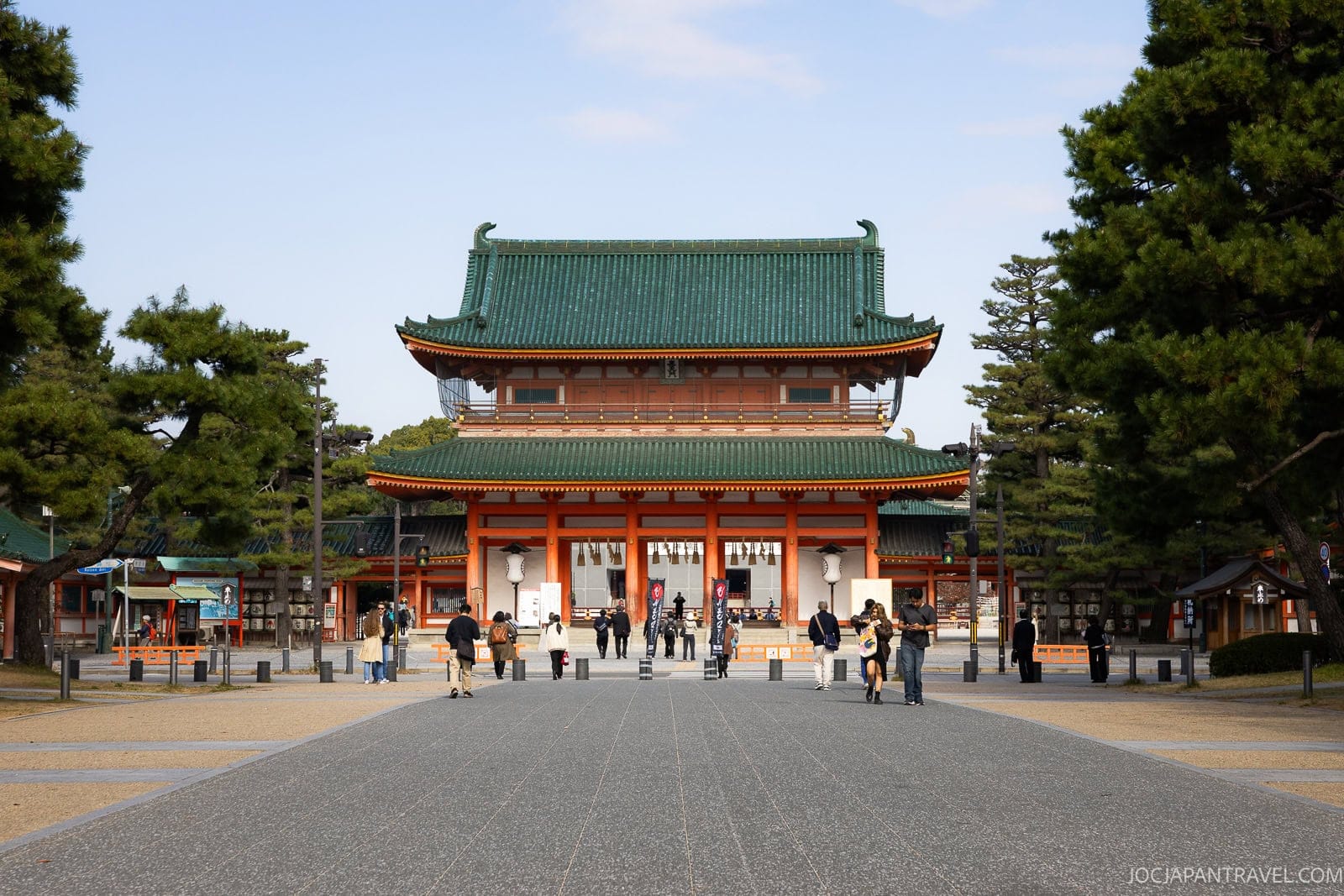
Heian shrine is a partial replica of the original Imperial Palace, rebuilt at the city’s eastern edge. The halls sit symmetrically around a wide gravel courtyard, which is unusual and gives the place a formality most Kyoto shrines lack.
The Daigokuden, the outer worship hall, and the Otenmon main gate are both Important Cultural Properties. Museums and Okazaki Park sit just outside the gate, and the park often hosts flea markets.
A Shrine Built for an Anniversary
Kyoto built the shrine in 1895 to mark 1,100 years since the capital was founded here. It honors the first and last emperors to rule from the city, Kammu and Komei. That makes it young by Kyoto standards, and it is worth knowing before you go. The halls copy Heian-period design rather than surviving from it.
Quick Facts
- Shrine grounds free. Shin’en Garden 600 yen
- Shrine hours: 6:00–17:30 from 15 February to 14 March, 6:00–18:00 from 15 March to September, 6:00–17:30 in October, 6:00–17:00 from November to 14 February
- Garden hours: 8:30–17:00 from 1 to 14 March, 8:30–17:30 from 15 March to September, 8:30–17:00 in October, 8:30–16:30 from November to February. Last entry 30 minutes before closing
- Open year-round
- The torii gate stands 24 meters tall, among the largest in Japan
- Shin’en Garden covers more than 30,000 square meters across four sections
- Renovation work on some buildings is scheduled to run until March 2031
My Experience at Heian Shrine
Some of the buildings were under wraps when I visited, and the scaffolding will be there for years. It did not spoil the visit. The garden is a separate ticket and a separate experience, and I spent most of my time there.
Shin’en Garden

Jihei Ogawa, the gardener known as Ueji, laid out Shin’en Garden in four parts. Each one draws on a different era, from the Heian period through to the Edo period. The government lists it as a Place of Scenic Beauty. You enter through the south and work your way around, which takes longer than you plan for.
The South and West Gardens
The south garden opens the route. Streams wind under weeping cherries, and the planting leans on species that turn up in classical Japanese literature, including The Tale of Genji. In early April, the cherries here are the reason people queue at the gate.
The west garden circles Byakko-ike pond. Irises and water lilies take over in early summer, and there is a waterfall and a teahouse. It is the most concentrated part of the garden and the easiest to photograph.
The Middle and East Gardens

The middle garden holds Soryu-ike pond and the Garyu-Kyo stepping stones. You cross the water on them, which is more fun than it sounds. A five-story pagoda sits beyond.
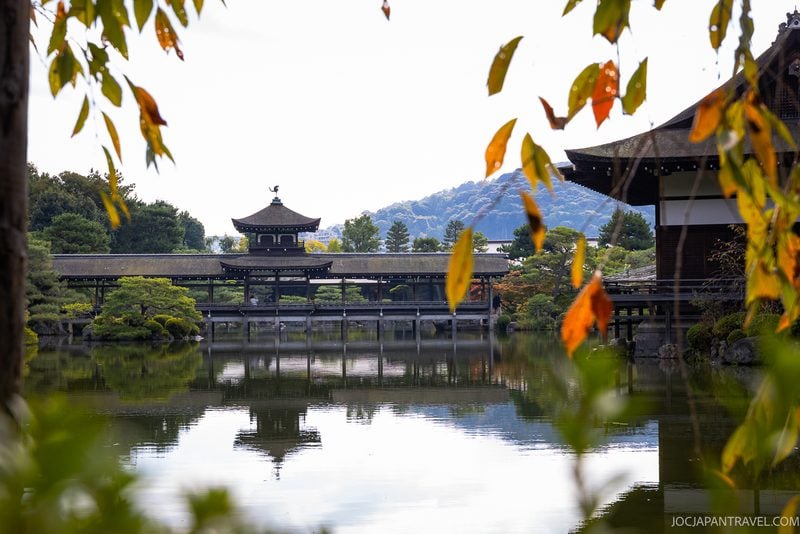
The east garden has the largest pond, Seiho-ike, and it was my favorite part. A roofed bridge crosses the water under a hinoki bark roof, and a two-story pavilion carries a bronze phoenix facing west. Benches line the edge. People feed the koi and watch the turtles, and nobody seems in a hurry.
Seasons and Festivals
The garden works in every season, which isn’t true everywhere in Kyoto. Cherries in the first half of April, maples in autumn, and snow on the ponds in winter. The shrine also runs Jidai Matsuri, the Festival of the Ages. A procession walks from the Imperial Palace to the shrine in costume spanning eight centuries of history.

Andy’s Travel Tips
These simple tips will help you when you visit.
- Pay for the garden. The shrine grounds are free and take fifteen minutes. The garden is the part worth the trip.
- Enter the garden from the south. The route is designed to run in one direction, and it builds toward the east pond.
- Expect scaffolding. Restoration runs until 2031, so some halls will be under cover whenever you go.
- Come in early April for the weeping cherries. The south garden is built around them, and it is the busiest week of the year here.
- Combine it with the eastern hills. Nanzen-ji and the Philosopher’s Path are a short walk away and make a natural half-day.
How to Get to Heian Shrine
Subway
Taking the subway avoids the heavy street traffic common around the nearby museum district.
- Higashiyama Station: Board the Kyoto Municipal Subway Tozai Line and ride to Higashiyama Station. Take Exit 1, head north along Jingu-michi street, and pass under the giant red torii gate; the shrine entrance is a flat 10-minute walk away.
Train
Rail lines connecting central Kyoto and Osaka provide convenient pedestrian approaches through the surrounding parks.
- Keihan Electric Railway: Take the Keihan Main Line to Jingu-marutamachi Station. From Exit 2, walk east down Marutamachi-dori avenue for about 10 to 12 minutes to reach the shrine grounds. Alternatively, disembark at Sanjo Station and walk northeast for about 15 minutes.
Bus
City bus routes drop off right along the perimeter of the shrine plaza and adjacent museums.
- From Kyoto Station: Head to Bus Stop A1 at the main terminal plaza and board Kyoto City Bus Route 5 or 105.
- Disembark at the Okazaki Koen / Bijutsukan / Heian Jingu-mae bus stop. The ride takes about 30 minutes depending on city congestion, dropping you off just a 3-minute walk from the main gate.
Taxi
- A taxi hailed from the stands outside the Hachijo or Karasuma exits of Kyoto Station takes approximately 20 to 25 minutes to reach the front entrance, costing between ¥2,000 and ¥2,800 depending on traffic.
The Giant Torii Gate: Standing 24.4 meters high over Jingu-michi street, the shrine’s main entrance gate is one of the largest torii gates in all of Japan. Built in 1928 to celebrate the coronation of Emperor Hirohito, it is officially registered as a Tangible Cultural Property.
Is Heian Shrine Worth Visiting?
Yes, but go for the garden rather than the shrine. The halls are impressive and photograph well, and they are also a replica barely a century old. Shin’en Garden is the real thing and the 600 yen is the best value in the area. If you are short on time and have already seen Nanzen-ji, this one can wait.
More to Explore Nearby
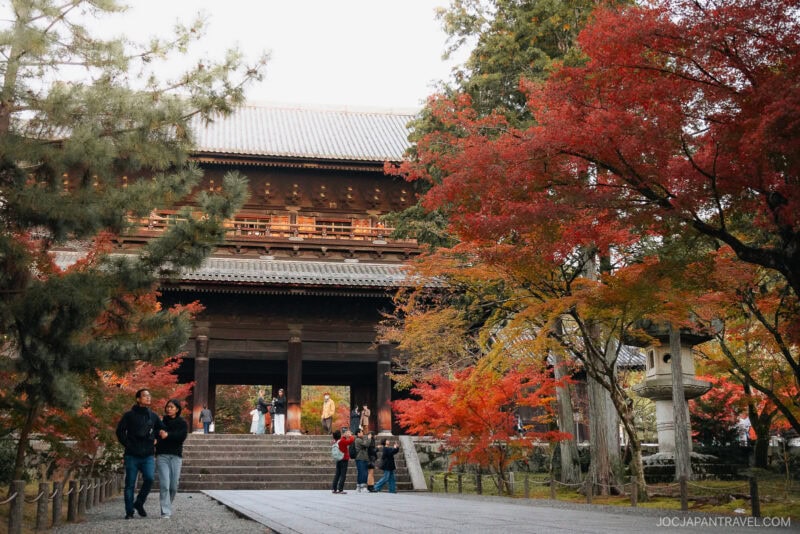
- Nanzen-ji – A grand Zen complex ten minutes south, with a brick aqueduct running through the grounds.
- Philosopher’s Path – The canal walk that starts near Nanzen-ji and runs north under the cherry trees.
- Ginkakuji – The Silver Pavilion at the far end of the Philosopher’s Path, and the natural end to the walk.
- Tofukuji – A large Zen temple south of here, best known for the maples filling its valley.