This post may contain affiliate links. Please read our disclosure policy.
Take a stroll through miniature Japan at Suizenji Jojuen, where a spring-fed pond, a small Mount Fuji, and a 400-year-old teahouse capture the spirit of the Edo period in the heart of Kumamoto City.
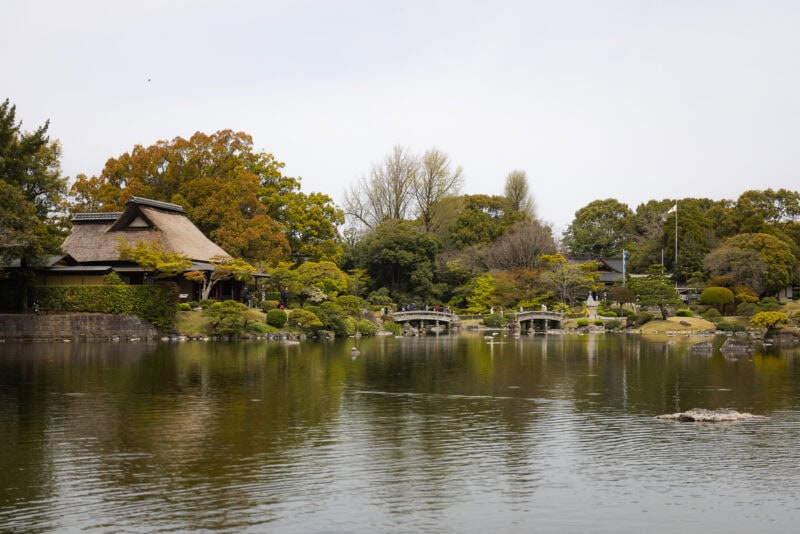
Suizenji Jojuen (水前寺成趣園) is a traditional Japanese stroll garden in the eastern part of Kumamoto City, originally established in the 17th century by Prince Hosokawa Tadatoshi as a Buddhist temple retreat.
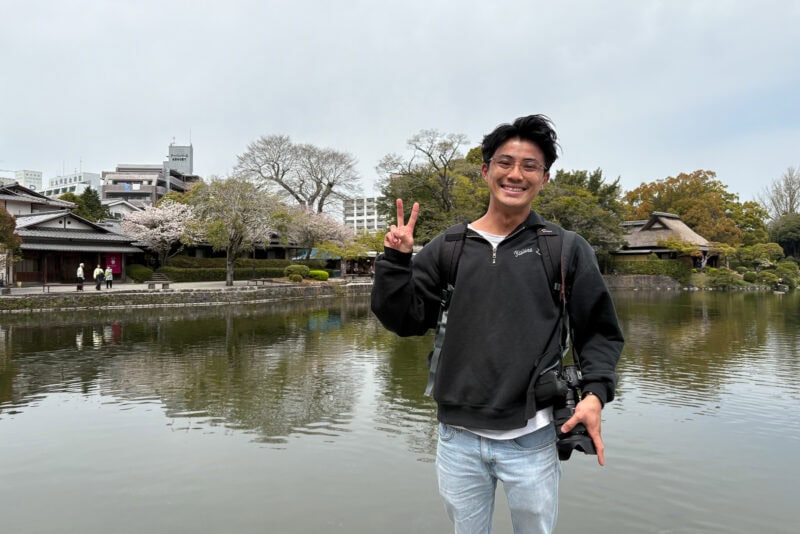
Over the centuries, it evolved into one of Kyushu’s finest examples of landscape design. Its layout miniaturizes the 53 stations of the Tokaido Road, the historic route between Kyoto and Edo. I visited in early April and was lucky enough to catch the last few days of cherry blossom season. The garden itself is immaculate, but the cherry blossoms made everything that much more picturesque.
A Stroll Garden in the Edo Tradition
Suizenji Jojuen’s designs follow the kaiyushiki, or stroll garden, format. The experience unfolds as you walk the circular paths. There is no single fixed point from which to take it all in.
The garden features a central pond fed by underground springs from Mount Aso. An artificial mountain modeled on Mount Fuji rises within the grounds. There are also two Shinto shrines and a 400-year-old teahouse. Pathways, stone bridges, and tree groves round it out, rewarding a slow, unhurried visit.
My Experience at Suizenji Jojuen
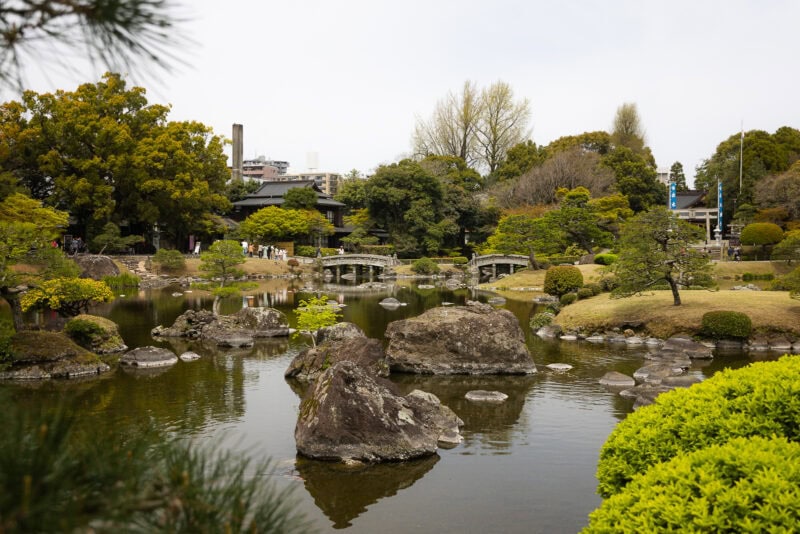
The garden rewards the kind of walking where you slow down and let things reveal themselves rather than moving toward a specific destination. The central pond reflects the surrounding greenery and the artificial Mount Fuji on its surface, and the stepping-stone paths branch off in multiple directions, each leading to a different framing of the same landscape. The design is about proportion and perspective, and it shows most clearly when you stop moving and just look.
Izumi Shrine and the Traditional Higo Flowers
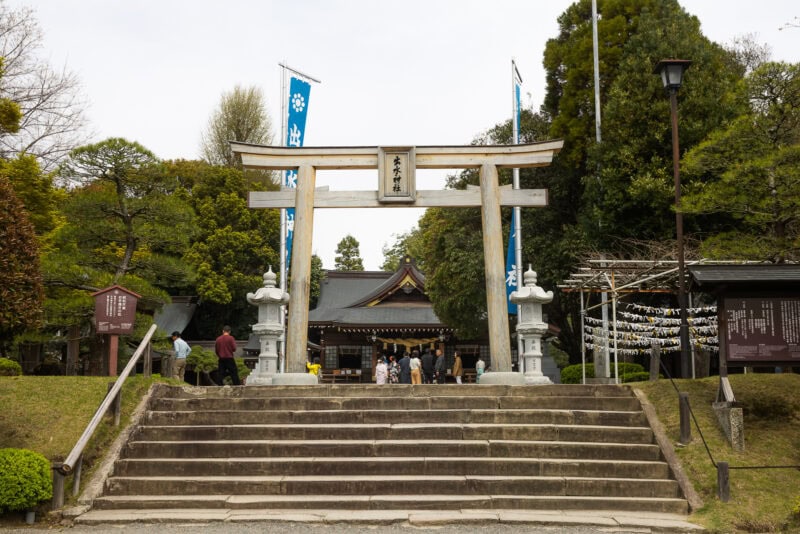
Crossing the Meiji-era stone bridges brings you to Izumi Shrine, a Shinto shrine devoted to the Hosokawa family who presided over more than 240 years of peace and prosperity in the region. The chozuya water basin here is fed by the “water of longevity,” a spring originating from Mount Aso. Beside the shrine stands a remarkably shaped pine tree that began life as a bonsai belonging to Hosokawa Tadatoshi in the first half of the 17th century and has grown into something genuinely extraordinary over the centuries.
Along the avenue leading to Izumi Shrine, five of the six traditional Higo flowers are planted. These are the Higo camellia, sasanqua, peony, chrysanthemum, and iris. In spring and autumn, the shrine hosts Yabusame, traditional horseback archery. It has been a yearly tradition here since 1878. If your dates align, it is worth timing your visit around it.
The Kokindenju-no-Ma Teahouse
The best way to finish your walk around the garden is at the Kokindenju-no-Ma Teahouse. The building is over 400 years old, originally from Kyoto, and was relocated to Suizenji Jojuen in 1912 following the destruction of the original teahouse during the 1877 Satsuma Rebellion.
Inside, the traditional tatami floors and decorated fusuma sliding doors open onto what I think is the best view of the garden from anywhere on the grounds. I recommend ordering a cup of matcha and a piece of seasonal wagashi to make the most of the view.

Andy’s Travel Tips
These simple tips will help you when you visit.
- Visit in late March to early April for the cherry blossoms. Around 150 trees bloom across the garden and the combination of the blossoms with the pond and the Mount Fuji hill is as good as Suizenji Jojuen gets.
- Walk slowly and take all the branching paths rather than following the main loop. The best views in the garden come from the smaller detours.
- End your visit at the Kokindenju-no-Ma Teahouse for matcha and wagashi. The sliding doors open onto the best garden view in the complex and it is the most peaceful way to close out the experience.
- Check if Yabusame horseback archery is scheduled during your visit. It runs as a yearly tradition at Izumi Shrine each spring and autumn and is worth timing around if you can.
- The tram from Kumamoto Station is the most relaxed way to arrive, taking about 30 minutes for 180 yen. The JR Hohi Line to Shin-Suizenji is faster at about 10 minutes but requires a 10-minute walk at the end.
How to Get to Suizenji Jojuen
Tram (Recommended)
The city tram is the most popular way to reach the garden from Kumamoto’s main hubs.
- From JR Kumamoto Station: Take the Kumamoto City Tram (Line A) toward Kengun-machi. Get off at Suizenji Koen. The garden entrance is a 3 to 5 minute walk from the stop.
- From Sakura-machi Terminal (Downtown): Take the City Tram (Line A or B) toward Kengun-machi. Get off at Suizenji Koen. The ride takes approximately 15 to 20 minutes.
Train
- From JR Kumamoto Station: Take the JR Hohi Line to Shin-Suizenji Station.
- From the station, it is about a 10-minute walk to the garden entrance.
By Car or Taxi
- From Kumamoto Station, a taxi takes about 15 to 20 minutes and costs roughly ¥2,000 to ¥2,800.
Is Suizenji Jojuen Worth Visiting?
Yes, particularly if you appreciate traditional Japanese garden design or want a quiet, unhurried stop in Kumamoto. At 400 yen, it is good value. The teahouse at the end makes it feel like a complete experience. It is more than just a walk through a park. It is not the most dramatic attraction in Kyushu, but it is beautifully curated. The spring and autumn seasons give it a real seasonal beauty. A well-timed visit makes it even more rewarding.
More to Explore Nearby
Suizenji Jojuen is right in the heart of Kumamoto, with the city’s other great landmarks just a short distance away and the wider charms of Kyushu easily within reach.
- Kumamoto Castle — One of Japan’s most impressive feudal castles, rebuilt after earthquake damage and more striking than ever. A must-pair with any visit to Suizenji.
- Sakuranobaba Josaien — A lively traditional shopping and dining complex at the castle gates, perfect for picking up local crafts and trying Kumamoto specialities like horse sashimi.
- Kurokawa Onsen — About 90 minutes north, this intimate hot spring village set in a forested gorge is one of Kyushu’s most beloved onsen destinations.
- Yanagawa Canals — A scenic hour-and-a-half north, the willow-lined waterways of Yanagawa make for a wonderfully unhurried half-day escape by flat-bottomed boat.