This post may contain affiliate links. Please read our disclosure policy.
Steeped in a history of faith, rebellion, and resilience, the Amakusa Islands are one of Kyushu’s most captivating and under-visited destinations, where peaceful coastlines, UNESCO-listed churches, and wild dolphins await just a short drive from Kumamoto.
Amakusa (天草) is an archipelago of two large islands and around 120 smaller ones, located southwest of Kumamoto City in western Kyushu. The area is known for its dramatic coastlines, deep cobalt waters, lush mountain interiors, charming fishing villages, and a resident dolphin population that draws visitors year-round. Along with its stunning landscapes, the more I learned about its history, the more it became one of my favorite areas in all of Kyushu. These are islands shaped by faith, conflict, and centuries of quiet resilience, and that history runs through everything you see here.
Table of Contents
History of the Amakusa Islands
Amakusa was one of the first Japanese ports to welcome Portuguese ships in the 16th century. Those merchants brought Western goods and introduced Christianity, and by 1589, the islands were home to one of Japan’s first Catholic seminaries. The faith spread quickly among locals, but changed dramatically in 1612 when the Edo Shogunate banned Christianity nationwide. Amakusa’s remote location and deep Christian roots made it a refuge for persecuted believers, who continued to practice in secret for over two centuries.
In 1637 and 1638, Amakusa and nearby Shimabara became the center of Japan’s largest civil uprising, the Amakusa-Shimabara Rebellion. Driven by oppressive taxation and religious persecution, the revolt was led by Amakusa Shiro, a 16-year-old local Christian who became one of the most enduring symbols of resistance in Japanese history. Understanding this history before you arrive changes how every church, castle, and coastal village feels when you are actually standing in front of it.
What to Do in the Amakusa Islands
Sakitsu Church
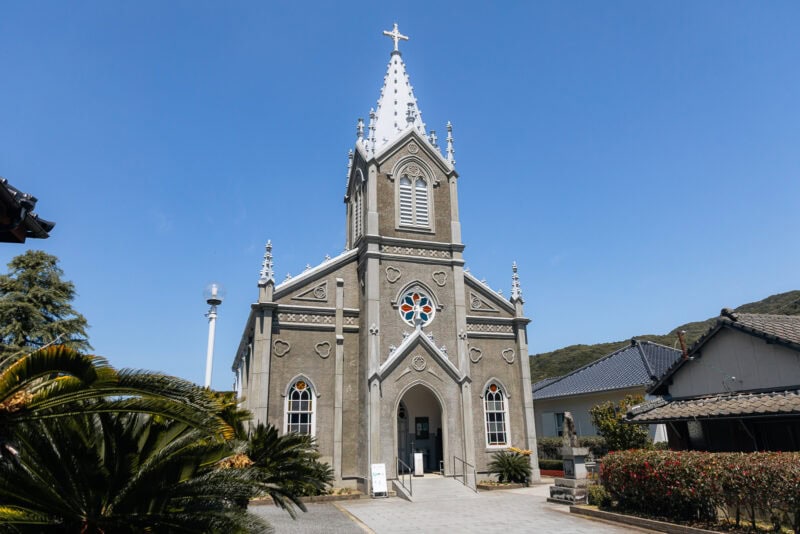
Sakitsu Village is one of the most renowned spots in Amakusa and one of twelve landmarks of the UNESCO World Heritage Site “Hidden Christian Sites in the Nagasaki Region.” The fishing village played a central role in the spread of Christianity in the 16th century, and the church at its heart carries that history in every detail.
The first proper church was built in 1888, fifteen years after the prohibition on Christianity was lifted. The current Sakitsu Church, a Gothic-style reconstruction built in 1934, dominates the village skyline, a presence that feels both striking and completely at home. Most unusually, the interior floors are laid with tatami mats, a gesture toward the surrounding Japanese environment that makes the space unlike any other church I have visited.
What stayed with me most was not the church itself but the village around it. The small streets and weathered houses still carry the atmosphere of a community that held onto its faith quietly for generations. It felt entirely removed from Kumamoto City.
- Hours: 9:00–17:00 | No regular closing days | Free admission
Oe Tenshudo Church
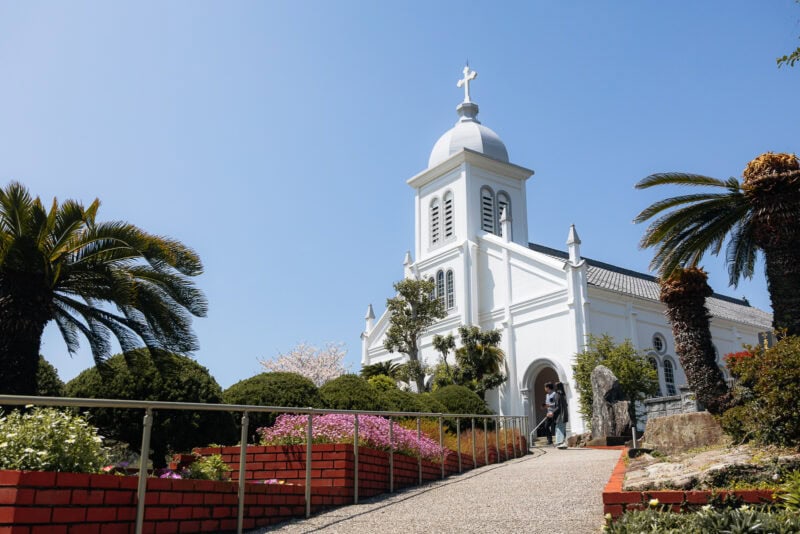
Oe Tenshudo Church was the first church built in Amakusa following the lifting of restrictions on Christianity, constructed in 1933 by French missionary Father Garnie, whose statue now stands inside beside the Virgin Mary. The interior is more traditionally church-like than Sakitsu’s, and the stained-glass windows are the highlight. It is a quieter stop than Sakitsu, with less to explore in the surrounding area, but if you are already in the vicinity, it is worth the short detour.
- Hours: 9:00–17:00 | No regular closing days | Free admission
Dolphin Cruise
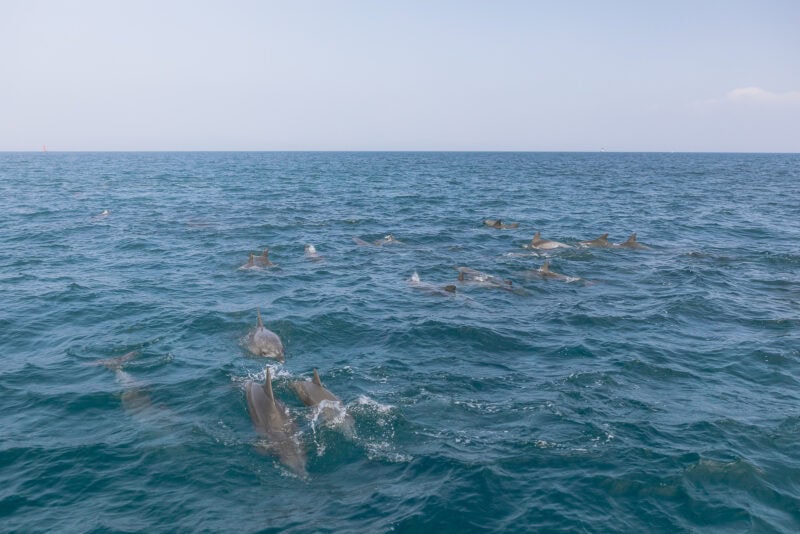
The dolphin cruise was one of the most surprising highlights of my entire Amakusa trip. Around 200 to 300 wild dolphins inhabit the waters off Tsujishima Island in Itsuwamachi Town, drawn by the area’s undulating sea floor and strong tidal currents that concentrate the small fish they feed on. The cruise takes you out into open water for approximately 50 minutes, and the dolphins swim alongside the boats without any encouragement. It is a genuine wild encounter rather than a managed attraction.
I booked online in advance, and it is the safer option during busy periods. On-the-day tickets are available at the Dolphin Center, but they can sell out. One note: the boats move with the sea, so if you are prone to seasickness, come prepared.
- Hours: 9:00–17:00 | Irregular closures in adverse weather | Adults 3,000 yen, Children 2,000 yen, Infants 1,000 yen (10% off when booked online)
Kuratake Shrine
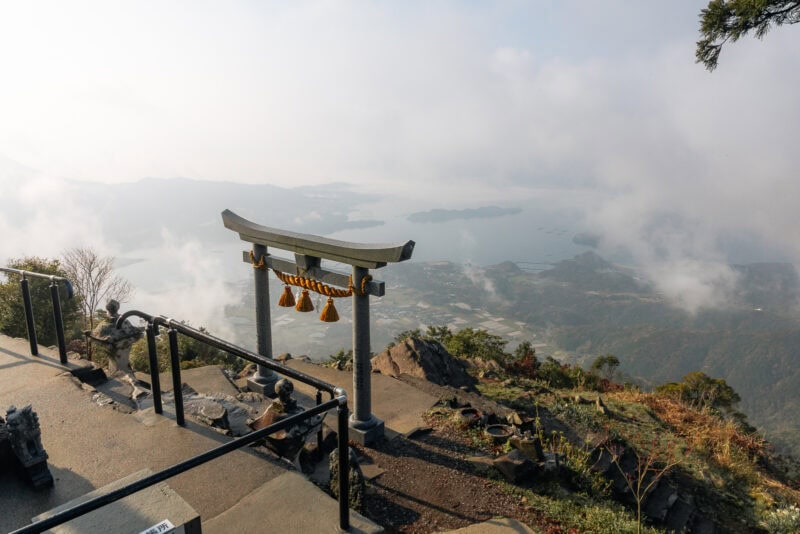
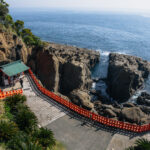
Mount Kuratake is the highest peak in the Amakusa Islands at 682 meters and has been revered as a sacred mountain since ancient times. At the summit is Kuratake Shrine, originally built to pray for the safety of fishermen. The view from up there is unlike anything I had seen before in Kyushu, looking out over the sprawling islands and sea with a lone stone torii gate framing the foreground. One important note: the road leading up to the shrine is very narrow with no guardrails in certain sections. Drive with extreme care and take it slowly.
- Hours: Open 24 hours | No regular closing days | Free admission
Tomioka Castle
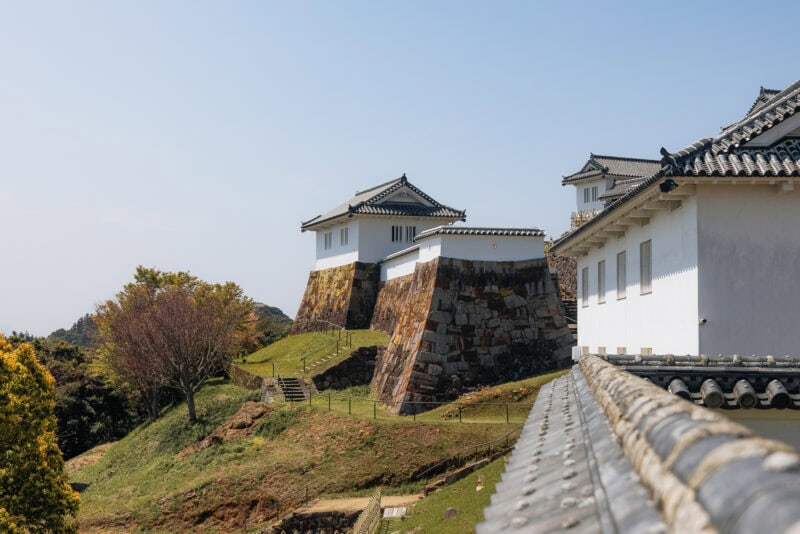
Built in 1602 on the Tomioka Peninsula on the western coast of Shimoshima Island, Tomioka Castle became one of the key battlegrounds during the Shimabara Rebellion in 1637, when Christian rebels fought their way to the Ninomaru compound before being forced back. The castle came under direct Tokugawa government control in 1670 and was largely dismantled, but sections of the original walls remain. The center of the grounds now houses the Tomioka Visitor Centre, with displays, hands-on exhibits, and 3D visuals covering the castle’s history, the region, and Amakusa’s coral reefs. It is a well-put-together museum and free to enter.
- Hours: 9:00–17:00 | Closed Wednesdays, January 1–3, May 2–5, August 13–15 | Free admission
Jumanyama Observation Point
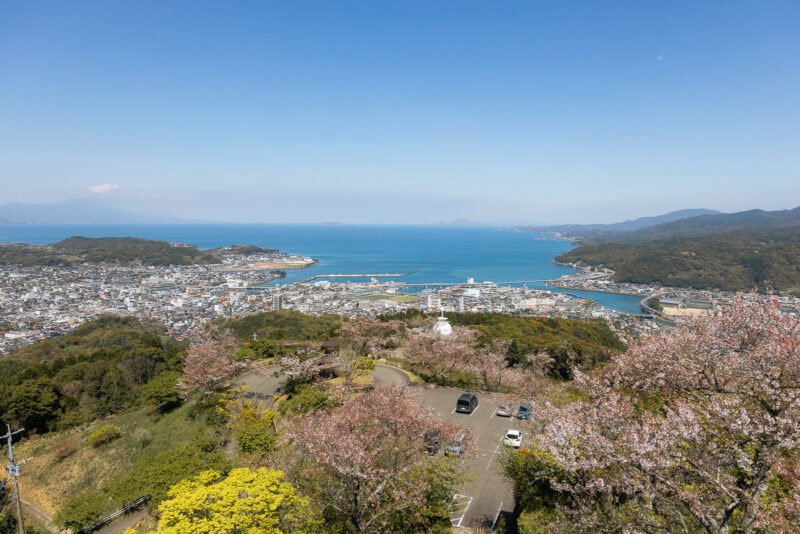
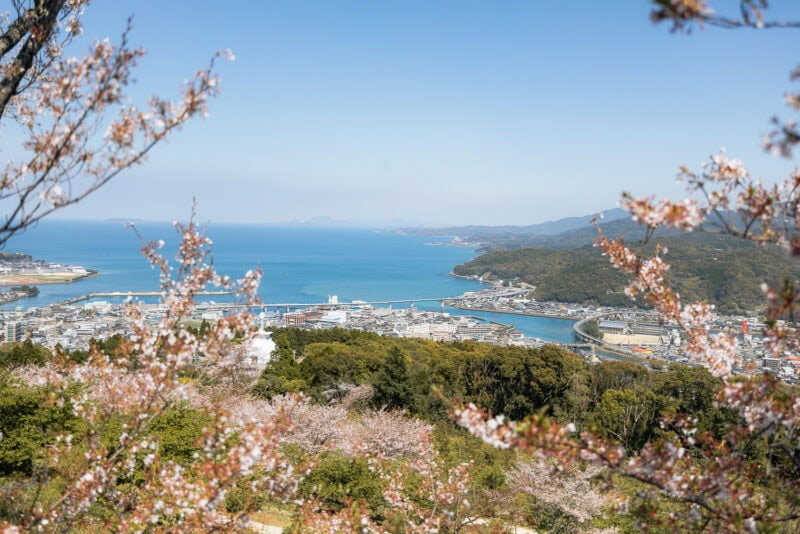
There are observation points all over the Amakusa Islands, but Jumanyama was a natural stop on my route back toward Kumamoto, and it did not disappoint. Sitting 220 meters above sea level, the panorama from here takes in Amakusa City, Hondo Port, Mount Unzen Fugendake, and the Shiranui Sea. From February to April, over 100 cherry trees bloom down the mountainside below the viewpoint, turning the slope into a sweep of pink that frames the coastal view beyond. Luckily, I caught the last few days of the blossoms on my visit.
- Hours: Open 24 hours | No regular closing days | Free admission

Andy’s Travel Tips
These simple tips will help you when you visit.
- Rent a car. Many of the best spots in Amakusa, including Kuratake Shrine and the coastal viewpoints, are only reachable by car. The coastal and mountain roads are some of the most scenic driving in Kyushu, which makes the car a part of the experience rather than just a convenience.
- Read about the Amakusa-Shimabara Rebellion before you go. Understanding the history of Christianity, persecution, and the uprising transforms every church, castle, and village from a sightseeing stop into something with genuine emotional weight.
- Book the dolphin cruise online in advance and to secure your spot during busy periods. On-the-day tickets are available at the Dolphin Center, but can sell out.
- Drive extremely carefully on the road to Kuratake Shrine. The road is very narrow and has no guardrails in sections. Take it slowly and be aware of oncoming traffic.
- Combine Sakitsu Church with a slow walk through the surrounding village. The church is the landmark, but the narrow streets and rustic houses around it are just as worth your time.
- Visit from March to April if cherry blossoms are a priority. Both Jumanyama Observation Point and the wider island are at their most scenic during this window.
How to Get to the Amakusa Islands
Train
There is no direct train service onto the islands themselves.
- From JR Kumamoto Station, take the JR Misumi Line to the terminal stop, Misumi Station. The ride takes about 50 minutes. From Misumi Station, you can walk to the ferry terminal (Misumi Port) to catch a boat to the islands or take a local bus across the “Five Bridges of Amakusa.”
Ferry
Taking a boat is the most scenic way to reach the islands and often faster than the bus.
- Amakusa Takara-jima Line: This high-speed ferry connects Misumi Port (near Misumi Station) to Matsushima (Maejima Port) and Hondo Port. The ride from Misumi to Matsushima takes about 20 minutes.
- Ferry from Shimabara: If you are coming from Nagasaki, you can take a car ferry from Kuchinotsu Port to Oniike Port in northern Amakusa. The crossing takes about 30 minutes.
Bus
The Amakusa Express Bus is a convenient direct option from the mainland.
- From Kumamoto Station or the Sakura-machi Terminal, take the “Amakusa-go” express bus. It travels to the main hubs of Matsushima (approx. 1 hour 30 minutes) and Hondo (approx. 2 hours 20 minutes).
Car
Driving is highly recommended for exploring Amakusa, as the islands are spread out and public transport is infrequent.
- From Kumamoto City, take Route 266 or Route 57 toward Misumi. You will cross the Five Bridges of Amakusa (Amakusa Gokyo), which offer spectacular views of the Ariake Sea. The drive from Kumamoto City to Hondo takes about 2 to 2.5 hours.
Are the Amakusa Islands Worth Visiting?
Without question. The Amakusa Islands are one of the most rewarding destinations I have visited in Kyushu, and they remain largely off the international tourist radar, which makes the experience feel all the more genuine.
The history alone would justify the trip, but the wild dolphin encounters, the views from Kuratake Shrine, and the quiet atmosphere of Sakitsu Village add up to something that is difficult to find anywhere else in Japan. If you are spending any real time in Kumamoto or Nagasaki and you have access to a car, the Amakusa Islands should be near the top of your list.