This post may contain affiliate links. Please read our disclosure policy.
Walk across the sky on Japan’s highest pedestrian suspension bridge. Below, the Naruko River drops 173 meters, with three waterfalls cascading through the gorge. The peaks of the Kuju mountain range frame the view beyond. Together, they make the Kokonoe Yume Suspension Bridge one of Kyushu’s most exhilarating viewpoints.

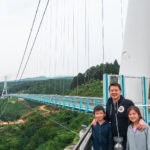
The Kokonoe Yume Suspension Bridge (九重夢大吊橋) stretches 390 meters across the Kyusuikei valley in western Oita Prefecture, suspended 173 meters above the Naruko River. Construction began in May 2004, and the bridge opened on October 30, 2006, becoming Japan’s highest pedestrian suspension bridge.
What makes its origin story memorable is that it was funded entirely by local residents and businesses, with no prefectural or national government subsidies. The name Yume, meaning “dream,” was chosen by the same local community that funded the project. Three hundred thousand people crossed it in the first month alone, and over a million in the first six months.
What to Expect at Kokonoe Yume Suspension Bridge
The Kokonoe Yume Suspension Bridge spans the Kyusuikei gorge above the Naruko River and offers unobstructed views of three waterfalls and the Kuju mountain range.
It is open year round. Admission is ¥500 for adults, ¥200 for elementary school children, and free for children under 6. From January through August and November through December, hours are 8:30 AM to 5:00 PM. In September and October, the bridge stays open until 6:00 PM. The bridge may close during bad weather. It is smart to check the official website before visiting.
Quick Facts
- Located in Kokonoe Town, about one hour from Beppu by car
- 390 meters long, 173 meters high, 1.5 meters wide; Japan’s highest pedestrian suspension bridge when it opened in 2006
- Funded entirely by local residents, with no government subsidies, and named Yume (“dream”) by the community
- Designed to withstand 1,800 people simultaneously and wind speeds up to 65 m/s
- Overlooks Shindo no Taki, a three-waterfall system dropping 88 meters, listed among Japan’s top 100 waterfalls
My Experience at the Kokonoe Yume Suspension Bridge

I have stood on some impressive bridges in Japan, with the Akashi-Kaikyo Bridge between Kobe and Awaji Island among the most breathtaking structures I have seen. The Kokonoe Yume Bridge does not rival it for scale, but the surrounding landscape offers a view that is every bit as dramatic in its own way.
Suspended 173 meters above the Naruko River, the bridge looks out over the Kyusuikei valley. It is framed by the Kuju mountain range, home to some of Kyushu’s highest peaks. These include Mount Daizen (1,729 m), Mount Mimatayama (1,745 m), and Mount Kuju (1,791 m).
The gorge below, the peaks above, and the waterfalls midway each draw your eye. It is the kind of view that makes you stop and admire it from different angles.
The View from the Bridge

The most impressive view from the bridge is Shindo no Taki, a system of three waterfalls dropping 88 meters into the valley: Kodaki (child falls), Medaki (female falls), and Odaki (male falls). The trio is recognized as one of Japan’s top 100 waterfalls and is visible in full from various points along the bridge.
Looking straight down is another matter. The drop to the Naruko River is 173 meters, which gave me a bit of a scare despite from comfortability with heights. The bridge is engineered to handle 1,800 people at once, and wind speeds up to 65 m/s, so it does not sway noticeably, which helps.
Seasonal Highlights and the Yume Burger
The bridge is worth visiting in any season, but the most dramatic windows are late April through May, when the valley fills with the pink cherry blossoms, and November, when the surrounding trees turn deep red and gold. January and February bring occasional light snowfall to the valley below, creating an entirely different atmosphere and making it worth the cold if you dress for it. Summer and early autumn keep the bridge open later into the evening, with last entry at 17:30.
After crossing, look out for the Kokonoe Yume Burger at the stalls near the entrance. It is a regional take on the famous Sasebo Burger, created as a nod to the sister-city relationship between Kokonoe Town and Sasebo City. Karaage and seasonal soft cream are also available, and a snack after the crossing feels well-earned.

Andy’s Travel Tips
These simple tips will help you when you visit.
- Visit in November for the autumn foliage. The valley below turns deep red and gold, and the contrast against the bridge structure and the waterfalls makes it the most visually striking time of year to cross.
- Wrap up warmly in winter and early spring. The bridge sits in a mountain valley and the wind chill at 173 meters can be significant, even on days that feel mild at lower elevations.
- Look for all three waterfalls of Shindo no Taki as you cross. Kodaki, Medaki, and Odaki are all visible from the bridge, and it is worth pausing to identify each one rather than simply looking down.
- Rent a car from Beppu. The bridge is in the mountains and the bus from Bungo-Nakamura Station has seasonal timetables that can be inconvenient. A car takes about one hour from Beppu and gives you the flexibility to combine the visit with Yufuin or Mount Aso on the same day.
- Check closing conditions before visiting. The bridge closes irregularly due to adverse weather, and a wasted mountain drive is an unpleasant outcome. The official website lists current conditions.

How to Get to Kokonoe Yume Suspension Bridge
Train
The nearest rail hub is Bungo-Nakamura Station on the JR Kyudai Main Line.
- From Hakata Station, take the Limited Express Yufu or Yufuin no Mori train to Bungo-Nakamura. The ride takes approximately 2 hours and 15 minutes.
- From Beppu or Oita, take a local or limited express train to Bungo-Nakamura. The ride takes about 1 hour to 1 hour and 30 minutes.
- Once at Bungo-Nakamura Station, you must transfer to a local bus or take a taxi to reach the bridge.
Car
Driving is the most recommended way to reach the bridge, as it allows you to easily combine the visit with a trip to Yufuin or Kurokawa Onsen.
- From Fukuoka, take the Oita Expressway and exit at Kokonoe IC. The bridge is about a 20-minute drive from the exit.
- From Yufuin, the drive takes approximately 30 to 40 minutes via the scenic Yamanami Highway.
Taxi
- A taxi from Bungo-Nakamura Station to the bridge takes about 15 to 20 minutes. The fare is roughly ¥3,500 to ¥4,500. This is often the best choice for small groups who miss the limited bus service.
Is the Kokonoe Yume Suspension Bridge Worth Visiting?
Yes, especially if you are already in the Oita or Kumamoto area with access to a car. The bridge itself takes less than 30 minutes to cross and back, but the surrounding scenery, the waterfall views, and the engineering backstory make it feel like more than a quick attraction.
At 500 yen entry it is good value, and in November or late spring it delivers the kind of view that is difficult to replicate anywhere else in Kyushu. It works well as a stop between Beppu and Yufuin, or as a detour on the way to or from Mount Aso.
More to Explore Nearby
- Kurokawa Onsen — The closest major onsen destination to the bridge, this intimate village tucked into a forested gorge is one of Kyushu’s most atmospheric hot spring escapes.
- Yufuin Kinrin Lake — A short drive into Yufuin brings you to this serene lake wreathed in morning mist, surrounded by traditional inns and cafes. One of the most photographed spots in Oita.
- Yunotsubo Kaido — Yufuin’s charming main street, lined with galleries, craft shops, and local food stalls. Perfect for a leisurely afternoon stroll after the bridge.
- Beppu Travel Guide — About an hour away, Japan’s hot spring capital offers a completely different onsen experience — steaming “hells,” sand baths, and a lively resort town atmosphere.