This post may contain affiliate links. Please read our disclosure policy.
From Tsutenkaku Tower to souvenir shops in Shinsekai, meet Billiken—the odd little “God of Things As They Ought to Be” and one of Osaka’s icons.
Meeting Osaka’s Mischievous Mascot
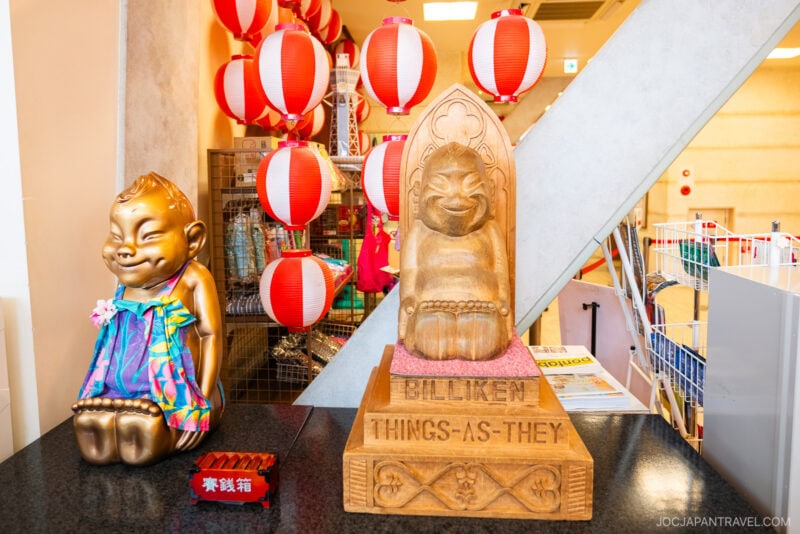
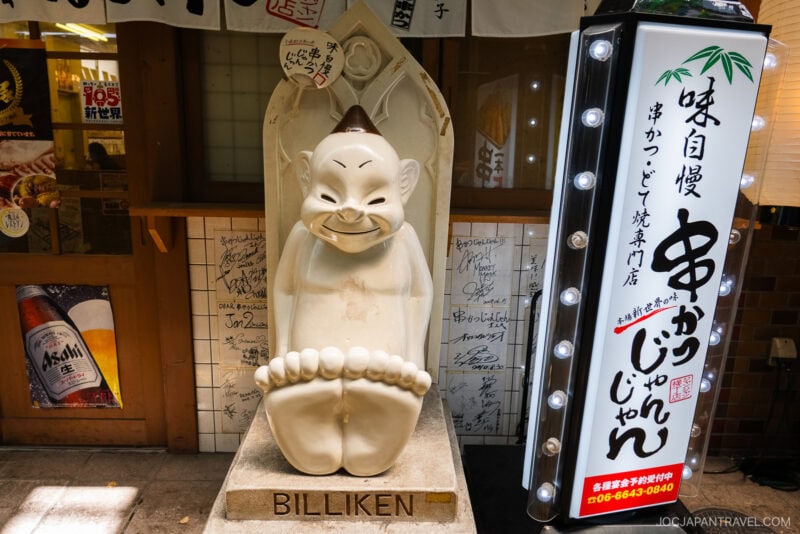
While exploring Shinsekai, Osaka’s retro-flavored neighborhood, we kept spotting a peculiar figure. He had pointy hair, a wide grin, and sat with his feet stretched forward. Billiken appeared everywhere, on manju wrappers, shop signs, and even inside Tsutenkaku Tower.
He might look like a traditional Japanese character, but Billiken’s roots are surprisingly far from Japan.
Who Is Billiken?

Billiken was created in 1908 by American illustrator Florence Pretz, who claimed she saw the figure in a dream. She sketched his elf-like face, round body, and pointed hair, calling him the “God of Things As They Ought to Be.”
Originally sold as a charm doll in the U.S., it was believed to bring luck, happiness, and prosperity. His popularity there faded quickly, but in Japan, his story was just beginning.
How Billiken Came to Osaka
In 1912, when Osaka was modernizing and Luna Park amusement park opened in the Shinsekai District, a statue of Billiken was placed there as a symbol of good fortune. Locals quickly warmed to the character and made him part of the neighborhood’s identity.
After Luna Park closed in 1923, the statue was removed from public view. When Tsutenkaku Tower was rebuilt in 1956, a new Billiken statue was installed in the observation deck. Visitors began rubbing his feet for luck so often that the soles have been replaced several times.
Today, Billiken is a familiar sight throughout Shinsekai. You can spot him in shop windows, on souvenirs, and even baked into sweets. The most well-known statue still sits inside Tsutenkaku Tower’s fifth-floor observatory, greeting visitors from above.
Billiken and Other American-Japanese Icons
Did you know? Billiken isn’t the only American-born character to find a second life in Japan. Kewpie, the cherubic figure on mayonnaise bottles, was created in 1909 by U.S. cartoonist Rose O’Neill. Like Billiken, he became a beloved part of Japanese pop culture.
How to Get to Billiken
Train
- From Ebisucho Station (Sakaisuji Line), about 1 minute on foot. Dobutsuen-mae Station (Midosuji and Sakaisuji Lines) is about 5 minutes on foot. From Shin-Imamiya Station (JR Loop Line) it’s about 7 minutes on foot.
Taxi
- Taxi is about 5-7 minutes from Osaka Station.
Head toward Tsutenkaku and you will see Billiken signs and shops.
Is Billiken Worth Visiting?
Seeing Billiken all over Shinsekai made us curious about where he came from. If you’re in the neighborhood or visiting Tsutenkaku Tower, take a moment to stop by and rub his feet for a bit of good luck.
More to Explore Nearby
As the symbol of luck for the Shinsekai district, Billiken is centrally located near some of Osaka’s most unique cultural spots, from the neighborhood’s iconic tower to famous street food and the massive entertainment area of Namba.
- Tsutenkaku Tower – Climb the observation deck of this iconic local landmark that defines the Shinsekai skyline and enjoy panoramic views over the old downtown area.
- Shinsekai – Immerse yourself in the nostalgic, old-school atmosphere of the surrounding entertainment district, famous for its retro charm and energetic downtown vibe.
- Yaekatsu Kushikatsu – Discover the local specialty of kushikatsu (deep-fried skewers) at a popular local restaurant where dipping twice into the communal sauce is strictly forbidden.
- Namba District – Head north to explore Namba, one of Osaka’s main entertainment and shopping hubs, known for its neon signs and lively nightlife.